Opposition to Genocide is not Terrorism – It is the IDF not Hamas That Should Be Proscribed
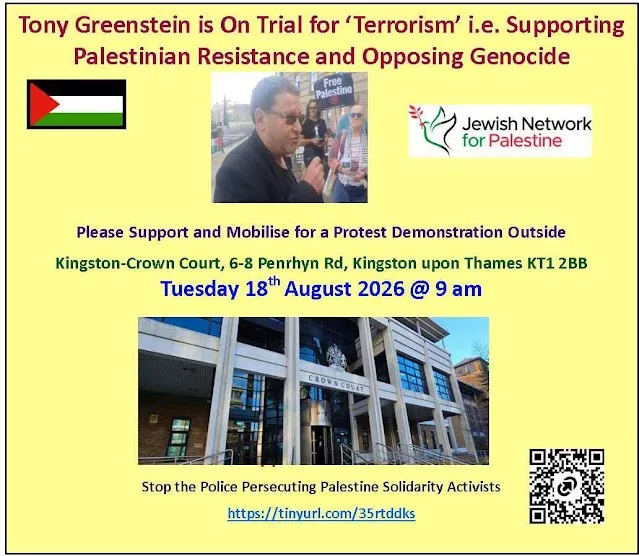
Defend Tony Greenstein Webinar 11August 2026 – On Trial at Kingston Crown Court 18th August 2026

Take Action in the Justice for Tony Greenstein Campaign https://share.google/YrEqom8ScxblditgC

Please donate to my Crowdfunder

The webinar on Tuesday evening, which nearly 300 people attended, was one of the most amazing that I’ve ever organised or spoken at. It expressed our determination that false allegations of ‘Terrorism’ will not deter us.
A range of speakers spoke in my support. I am on trial next week under the s.12(1) of the Terrorism Act 2000 accused of ‘inviting support’ for Hamas. As I have repeatedly made clear, I don’t support Hamas politically but I do support the right of the Palestinians to resist the Israeli state.

Speakers included Ali Abunimah, Editor of the Electronic Intifada; Annette Norman, mother of Filton 25 defendant Maddy Norman; Lubna Speitan who is proposing the Zionism is Racism motion at Green Party Conference; Ghada Karmi, author, academic and child survivor of the Nakba; Ronnie Kasrls, a former commander of the ANC’s military wing Umkonte we Sizwe in the struggle against South African apartheid and Intelligence Minister in Nelson Mandela’s first government and Huda Ammori, co-founder of Palestine Action and Tony Greenstein.
The Terrorism Act is being used against activists in the Palestine solidarity movement not terrorists. The British Judiciary has thrown off its mask as it sentences defendants for terrorism whilst keeping juries ignorant of the fact that convicting someone for criminal damage will mean that are sentenced as terrorists.

InJustice Jeremy Johnson, furious at the acquittal of the first 6 of the Filton 25 defendants on the most serious charges, filed Contempt of Court charges against Rajiv Mennon KC for informing the Jury of their right to decide a case on the basis of their own conscience and convictions. It’s called Jury Nullification or Equity. A historic legal power going back to the Bushell’s Case in 1670. It’s even on a plaque on the wall of the Old Bailey.

The case against Rajiv Menon KC is the first time in British legal history that a barrister is being accused of contempt of court for having defended his own clients.
I have gone back to the original debate on the Terrorism Act in December 1999 to see how the government represented the legislation at the time.
The government, in the form of Jack Straw, lied to the House of Commons repeatedly. Terrorism was redefined in the Act to include ‘serious’ damage to property.

For most people, terrorism is about violence and terror directed at a civilian population not attacks on factories of death run by Israel’s Elbit Systems.
3 dictionary definitions of Terrorism don’t mention anything about property. The Cambridge Dictionary says that terrorism is ‘violent action or threats designed to cause fear among ordinary people, in order to achieve political aims.’
The Miriam Webster definition of terrorism is ‘the systematic use of terror especially as a means of coercion’ and the
Oxford Reference Definition is ‘The calculated use of violence or threat of violence to inculcate fear.
What Chamberlain J called the ‘colloquial’ definition of Terrorism bears no relationship to s.1 of the Terrorism Act.
“An action done for the purposes set out in s. 1(1)(b) and (c) constitutes terrorism if it involves serious damage to property even if it does not involve violence against any person or endanger life or create a risk to health or safety… [T]his definition of ‘terrorism’ makes the statutory concept wider than the colloquial meaning of the word.”
What Blair & Straw were really saying is that Black = White. It is a combination of both Newspeak and Doublethink. Terrorism is not violence against property but violence against people. Violence, by its very nature, is directed at living creatures not inanimate objects.
The official WHO definition of violence restricts the term to the intentional use of physical force or power against oneself, another person, or a group.

Former Defence & Foreign Minister of Israel, Avigdor Liberman accused Netanyahu of Supporting ISIS Gangs Against Hamas
Jack Straw’s original target in 1999 was the animal liberation movement not Palestine solidarity. He said:
There are people who claim to be in favour of so-called animal liberation who have engaged in actions that not only caused risks but resulted in the most serious violence to individuals, and have put people under threat of their lives. Such circumstances may well fall within the ambit of clause 1
In the parliamentary debate Conservative MP Douglas Hogg presciently warned that
By extending the definition of terrorism, we put at risk our long tradition of giving sanctuary to people who are fighting oppressive regimes abroad. I do not want protesters to be classified as terrorists.

Alan Simpson explained that that many MPs were involved in international campaigns, such as those involving the action of Kurds in resisting being driven from their lands by the building of the Ilusu dam, the resistance of the Ogoni in Nigeria to the theft & pollution of their lands & the resistance of the Amazon Indians to the destruction of the rain forests
Straw lied when reassuring Simpson:
people supporting one or another of the international causes he cites will not even remotely come under the Bill…. However, to think that the Bill will restrict the right of peaceful protest, demonstration and campaigning is wholly erroneous.
Simon Hughes of the Lib Dems made a similar point.
…the Bill’s definition sweeps in not only people who attack property for an environmental objective or for objectives connected with other general issues such as animal rights, but people who support organisations outside Governments in countries that are not democratic. All those people would now be included in the definition.
Jeremy Corbyn pointed out that
Calling your opponents ‘terrorists’ is a familiar tactic of repressive states and it was something that New |Labour was about to introduce in this country.
Jack Straw said that ‘an organisation becomes a candidate for proscription only if it is concerned in terrorism’ which begged the question as to what terrorism was.

David Anderson QC, the Independent Reviewer of Terrorism Legislation in his 2012 Report wrote that:
the current law allows members of any nationalist or separatist group to be turned into terrorists by virtue of their participation in a lawful armed conflict, however great the provocation and however odious the regime which they have attacked.
David anderson QC
Straw admitted that ‘The power of proscription is of course an extreme power’ yet it is left to the absolute discretion of the Home Secretary, subject only to a cursory debate in Parliament as to who is proscribed. He lied when he said that
if the Secretary of State decides to proscribe an organisation, a judicial commission known as the Proscribed Organisations Appeal Commission (POAC) will make the final decision about any proscription.
It is the Home Secretary who makes the final decision. POAC is only relevant if there is an appeal against proscription and it has never made such a decision. It also deals with process not the merits of the decision.
Douglas Hogg pointed out that Kurdish representatives had asked the previous government for support in their campaign against Saddam Hussein and ‘On the face of it, that falls within the scope of action capable of constituting terrorism’..’ He went on to point out that a decision not to prosecute was left in the hands of the Attorney General.
I understand the right hon. Gentleman to be saying not that I am wrong, but that no one would be prosecuted for encouraging the Kurds to take such action, because of the discretionary power of the prosecution authority. That, however, is a profoundly unattractive situation.
In response Straw accused Hogg of having a ‘fevered imagination’. Well the fever has come to pass because the Kurdish Workers Party, the sister party of the Democratic Union Party in Syria, has been proscribed. Why? Because the dictator of Turkey, Recip Erdogan, is our friend. Whereas the PYD fought against ISIS with the Americans.
Alan Simpson asked ‘Who will define serious violence against the person (and)… against property? given the Judiciary’s ‘long history of a much more limited and destructive set of interpretations subsequently being placed on words used in legislation’. He asked
Who will then say when an act of terrorism falls outside the scope of existing criminal law, in relation to the advancement of a political, religious or ideological cause?
Douglas Hogg pointed out that
The definition of terrorism goes far beyond the traditional definition. Historically and in previous enactments, we have essentially directed our attention to campaigns against the state,… the Bill includes attacks on the corporate estate, which is an extraordinary departure in our concept of terrorism.’
Hogg raised the prospect of direct action groups like Greenpeace and Friends of the Earth being targeted:
I strongly disapprove of all those characters, … However, if I ask myself whether they should be treated as terrorists, I am bound to say, no way.
One of the most detestable creatures in the Blair government Charles Clarke told the Commons that
We are considering which international groups it might be appropriate to add, taking into account such factors as the nature and scale of the group’s activities, the specific threat that they pose to UK and British nationals abroad, the extent of their presence in the UK, and the need to support other members of the international community in the global fight against terrorism. However, I emphasise that proscription is a heavy power; it will be used only when absolutely necessary.
This too was a lie. Hamas was proscribed in 2001 yet it had no connection whatever with the UK. But judges too aren’t above lying.

When the Court of Appeal ruled on 15 June 2026 that Palestine Action’s proscription was lawful, they contrasted them with the Suffragettes. Liar-in-Chief ‘Lady’ Justice Carr quoted Lord Hoffman approvingly on how:
People who break the law to affirm their belief in the injustice of a law or government action are sometimes vindicated by history. The suffragettes are an example which comes immediately to mind. It is a mark of a civilised community that it can accommodate protests and demonstrations of this kind. But there are conventions which are generally accepted by the law-breakers on one side and the law-enforcers on the other. The protesters behave with a sense of proportion and do not cause excessive damage or inconvenience. And they vouch the sincerity of their beliefs by accepting the penalties imposed by the law. The police and prosecutors, on the other hand, behave with restraint and the magistrates impose sentences which take the conscientious motives of the protesters into account.
This was utter rubbish as often happens when judges quote each other. The level of repression directed against the Suffragettes was enormous and their activities were anything but restrained. The Police attacks on them were brutal. Carr said that:
Palestine Action characterises itself as a non-violent “direct action protest group” which follows in the footsteps of the suffragettes, and the campaigns against apartheid and the Iraq war.
It was not accurate for Ms Ammori to paint Palestine Action as an “ordinary protest group engaged in activities that fall within the well-established tradition of peaceful protest”.
Palestine Action’s activities are planned and undertaken secretly with the objective of avoiding detection …
Secondly, the members of Palestine Action do not vouch their sincerity by accepting the penalties imposed by the law. Thirdly, on a fair analysis, Palestine Action has little or nothing in common with the suffragettes or the anti-apartheid or Iran War protest groups.
The whole premise of Palestine Action is to cause damage to property belonging to Elbit and other companies trading lawfully in the United Kingdom. (my emphasis)
It is, nonetheless, a fundamental mistake to overlook the fact that Palestine Action overtly promotes unlawful violence amounting to terrorism. It is not, as it claims, a direct action civil disobedience protest group like the suffragettes operating transparently in the open. It is a covert organisation that operates using secret cells to avoid the detection and prosecution of those using violence to destroy the property of third parties. Palestine Action’s activities have caused injury as well as property damage.
Palestine Action was therefore a violent terrorist organisation, operating covertly unlike the genteel folk of the Suffragettes.
Yet the true record of the suffragettes was anything but peaceful. From 1912-14, they openly embarked on a terror campaign, bombing and burning their way across the country. Unsurprisingly the Suffragettes didn’t plan their arson or bombing campaigns in open meetings.

Simon Webb, the Author of The Suffragette Bombers: Britain’s Forgotten Terrorists wrote in a letter to the Guardian that:
Mary Leigh (who) acting with others, poured petrol over the carpets of a crowded theatre, set fire to it and then detonated a bomb. She and the others were later charged with “causing an explosion of a nature likely to endanger life”…. The women were not charged with terrorism as such, because no such offence existed at that time. The bomb explosions in places such as Westminster Abbey could hardly be called anything other than terrorism … the first terrorist bomb explosion in 20th century Ireland, at Lisburn’s Christ Church Cathedral in August 1914, (it) was the work not of the IRA, but the suffragettes.
Below are just a few examples of the peaceful, ‘transparent’ Suffragettes that Liar Lady Justice Carr referred to:
Attacks on Racecourses and Sports Pavilions
Ayr Racecourse (1913): The grandstand at this Scottish racecourse was completely burned to the ground in a dead-of-night arson attack. [1]
Kelso Racecourse: Suffragettes attempted to burn down the grandstand to disrupt racing events. [1]
Wimbledon Tennis Club (1913): An arson attempt was made to burn down the main tennis club house. [1] Golf Course Sabotage: Activists poured acid onto greens—notably those frequented by Members of Parliament—to burn “Votes for Women” into the turf. [1, 2]
In 1913 the grandstand of the Manor Ground football stadium in Plumstead was also burned down, costing £1,000 in damages.[36
On 11 April 2012, the cricket pavilion at the Nevill Ground in Royal Tunbridge Wells was destroyed in a suffragette arson attack.[48
Hurst Park Racecourse grandstand and royal boxes were completely destroyed by fire on June 9, 1913. Suffragettes Kitty Marion and Clara Elizabeth Giveen carried out the attack
Bombings and High-Profile Arson
The campaign saw the widespread deployment of improvised explosive devices (IEDs) and petrol-fueled fires. [1, 2]

David Lloyd George’s House (1913): A bomb exploded at a house under construction for the Chancellor of the Exchequer in Walton-on-the-Hill.
Theatre Royal, Dublin (1912): Suffragettes deployed several bombs and used petrol to set fire to the theatre during a live performance attended by Prime Minister H.H. Asquith.
Westminster Abbey (1914): A bomb was detonated inside the historic abbey, damaging the Coronation Chair.
Kew Gardens Tea Pavilion (1913): The famous tea pavilion was entirely destroyed by arson. Weeks prior, suffragettes smashed orchid houses and destroyed rare plants.
The Home Office (1912): A powerful bomb was discovered and safely defused in Home Secretary Reginald McKenna’s office.
Holloway Prison: A bomb was detonated outside the walls of the facility holding imprisoned suffragettes.
Bombs exploded at Edinburgh’s Royal Observatory, Rosslyn Chapel, St. Paul’s Cathedral, train stations (like Oxted and Westbourne Park), and various public infrastructure sites
Assaults, Vandalism, and Infrastructure Sabotage
Assassination Attempt on the Prime Minister: In July 1912, a suffragette threw a hatchet at Prime Minister Asquith’s carriage. It missed him but struck and injured Irish nationalist MP John Redmond. [1, 2, 3, 4]
Nationwide Postal Sabotage (1912–1914): Suffragettes launched a systemic campaign targeting public pillar boxes. They poured ink, corrosive acids, and liquid phosphorus into postboxes to destroy mail, occasionally leaving postal workers and police officers with chemical burns. [1, 2, 3]
Art Destruction (1914): Activist Mary Richardson entered the National Gallery and used a meat cleaver to slash Diego Velázquez’s famous painting, the “Rokeby Venus,” protesting the re-arrest of Emmeline Pankhurst. [1, 2, 3]
Mass Window Smashing (1912): Hundreds of women concealed hammers in their bags and simultaneously smashed the windows of commercial shops and government buildings across London’s West End.
In their attempts to destroy the direction action movement, Judges lie. The Terrorism Act 2000 is built on a series of lies. Lying is an integral part of the system we live in. When Burnham and Starmer say there is no Genocide in Gaza they lie. When the Court of Appeal says that making quadcopters to murder civilians is a ‘lawful business’ they lie. And if the law says child murder is lawful then it is not a law that should be given the time of the day.
Zoom has produced a summary which can be found here!
Tony Greenstein

I was born in Brighton, I am Jewish, I am very media connected as the retired managing director of a major record company and I am truly horrified at your bollocks ! You talk shite. You are wrong in everything you spew. What a total cunt you are !! Go fuck yourself cunt !
You will notice that this jerk, apart from sending it 3 times, doesn’t anywhere explain why I am ‘talking shite’.
I guess this is all one can expect of a Zionist. Hate is all they have to express and they think being Jewish excuses it
Do you have a comment based on evidence and reason, or do you just have mindless abuse? It’s long been revealing to me how pro-Israel commenters so often don’t even try to justify their apartheid state’s criminal actions, and resort to often childish swearing instead.
when I was young Zionists controlled the narrative. It was hard going for pro-Palestinian voices to get heard. But now they can’t justify their project so they resort to the kind of mindless abuse that Neil Feris used. That is literally all they have got to say. It is a form of Jewish fascism
Hi Tony, a really great speech!
Me and Charlotte are in Riga at the moment, visiting friends. We have visited the Ghetto museum from where in the end of 1941 38.000 Latvian and German jews were taken to surrounding woods to be executed by SS and police forces.
You have no words when You compare these brutal historical facts with the ongoing genocide against the Palestinians.
All the best, Hermann Dierkes, former city councillor in Duisburg/Germany
thank you Hermann. You are absolutely right. The Zionists are the inheritors of the European racial nationalism that produced a holocaust
Congratulations and well done ‘old man’
You believed
You fought
You won
Bravo.