There
was a time when Israel refused to use dogs, particularly German shepherd dogs,
against demonstration. Maybe I should
correct this. There was a time when
Israel refused to use dogs against Jewish
demonstrations because it was all too reminiscent of the use of dogs by
the Nazi SS against Jews. As far as I’m aware this is still the case. However, as you might be aware, Palestinians are not Jews and the prohibition therefore doesn’t apply.
was a time when Israel refused to use dogs, particularly German shepherd dogs,
against demonstration. Maybe I should
correct this. There was a time when
Israel refused to use dogs against Jewish
demonstrations because it was all too reminiscent of the use of dogs by
the Nazi SS against Jews. As far as I’m aware this is still the case. However, as you might be aware, Palestinians are not Jews and the prohibition therefore doesn’t apply.
Clearly
such inhibitions don’t apply to their
use against Palestinian civilians. The
attack below is particularly outrageous.
A dog is sent into a house that is being raided with no other purpose
than to attack those inside. The excuse
by the Israeli Army that the man they wanted was not coming out is an obvious
lie. The soldiers could have gone in
without the dog to extract him.
such inhibitions don’t apply to their
use against Palestinian civilians. The
attack below is particularly outrageous.
A dog is sent into a house that is being raided with no other purpose
than to attack those inside. The excuse
by the Israeli Army that the man they wanted was not coming out is an obvious
lie. The soldiers could have gone in
without the dog to extract him.
Tony
Greenstein
Greenstein
Bursting into a schoolteacher’s house in the middle of the night,
soldiers sicced their dog on him. The dog bit him and held on, as his family
looked on, horrified
soldiers sicced their dog on him. The dog bit him and held on, as his family
looked on, horrified
and
Feb 16, 2018
1:52 AM
1:52 AM
 |
| Mabruk and Innas Jarrar in the hospital. Alex Levac |
It’s not an easy sight to look at. His wife shows us the photographs on
her phone: his wounded arm, battered and bleeding, mauled and mangled, scarred
along its entire length. The same with his hip. It’s the aftermath of the night
of horror he endured, together with his wife and children.
her phone: his wounded arm, battered and bleeding, mauled and mangled, scarred
along its entire length. The same with his hip. It’s the aftermath of the night
of horror he endured, together with his wife and children.
Imagine: The front door is blasted open in the middle of the night,
soldiers burst violently into the house and set a dog upon him. He falls to the
floor, terrorized, the teeth of the vicious animal gripping his flesh for a
quarter of an hour. All the while, both he and his wife and children are
emitting bloodcurdling screams. Then, bleeding and wounded, he’s handcuffed and
taken by the soldiers into custody, and denied medical aid for hours, until
he’s taken to the hospital, which is where we met him and his wife this week.
There, too, he had been under arrest, forced to lie shackled to his bed.
soldiers burst violently into the house and set a dog upon him. He falls to the
floor, terrorized, the teeth of the vicious animal gripping his flesh for a
quarter of an hour. All the while, both he and his wife and children are
emitting bloodcurdling screams. Then, bleeding and wounded, he’s handcuffed and
taken by the soldiers into custody, and denied medical aid for hours, until
he’s taken to the hospital, which is where we met him and his wife this week.
There, too, he had been under arrest, forced to lie shackled to his bed.
That near-lynching was perpetrated by Israel Defense Forces soldiers on
Mabruk Jarrar, a 39-year-old Arabic teacher in the village of Burkin, near
Jenin, during their brutal manhunt for the murderer of Rabbi Raziel Shevach
from the settlement of Havat Gilad on January 9. And if that wasn’t enough, a
few days after the night of terror, soldiers returned again in the dead of
night. The women in the house were forced to disrobe completely, including
Jarrar’s elderly mother and his mute and disabled sister, apparently in a
search for money.
Mabruk Jarrar, a 39-year-old Arabic teacher in the village of Burkin, near
Jenin, during their brutal manhunt for the murderer of Rabbi Raziel Shevach
from the settlement of Havat Gilad on January 9. And if that wasn’t enough, a
few days after the night of terror, soldiers returned again in the dead of
night. The women in the house were forced to disrobe completely, including
Jarrar’s elderly mother and his mute and disabled sister, apparently in a
search for money.
The orthopedics ward in Haemek Hospital in Afula, Monday. A narrow room,
three beds. In the middle one is Jarrar, who has been here for about two weeks.
On Sunday morning the schoolteacher was still shackled to his bed with iron
chains, and soldiers prevented his wife from tending to him. The soldiers left
at midday after a military court ordered Jarrar’s unconditional release.
three beds. In the middle one is Jarrar, who has been here for about two weeks.
On Sunday morning the schoolteacher was still shackled to his bed with iron
chains, and soldiers prevented his wife from tending to him. The soldiers left
at midday after a military court ordered Jarrar’s unconditional release.
It’s not clear why he was arrested or why the troops set the dog on him.
His left arm and his leg are bandaged, the searing pain that still
accompanies every movement is plainly visible on his face. His wife, Innas, 37,
is by his side. They were married just 45 days ago, the second marriage for
both. His two children from his first marriage – Suheib, who’s 9, and
5-year-old Mahmoud – were eyewitnesses to what the soldiers and their dog
wrought on their father. The children are now staying with their mother, in
Jenin, but their sleep is troubled, Jarrar tells us: They wake up with
nightmares, shouting for him, and wetting their beds out of fear.
accompanies every movement is plainly visible on his face. His wife, Innas, 37,
is by his side. They were married just 45 days ago, the second marriage for
both. His two children from his first marriage – Suheib, who’s 9, and
5-year-old Mahmoud – were eyewitnesses to what the soldiers and their dog
wrought on their father. The children are now staying with their mother, in
Jenin, but their sleep is troubled, Jarrar tells us: They wake up with
nightmares, shouting for him, and wetting their beds out of fear.
Jarrar teaches Arabic in Hisham al-Kilani Elementary School in Jenin. On
Friday, February 2, he and his wife went to bed about midnight. Asleep in the
adjacent room were his two sons, who stay with him on weekends. At about 4
A.M., the family was awakened by an explosion that came from the direction of
the front door. Several windows in the house were shattered by the force of the
blast. Jarrar leaped out of bed and rushed to be with the children. IDF jeeps
were parked outside. A huge dog, apparently from Oketz, the army’s canine unit,
was brought into the house, followed by at least 20 soldiers, according to the
couple. It’s not hard to imagine the horror that seized them and the children.
Friday, February 2, he and his wife went to bed about midnight. Asleep in the
adjacent room were his two sons, who stay with him on weekends. At about 4
A.M., the family was awakened by an explosion that came from the direction of
the front door. Several windows in the house were shattered by the force of the
blast. Jarrar leaped out of bed and rushed to be with the children. IDF jeeps
were parked outside. A huge dog, apparently from Oketz, the army’s canine unit,
was brought into the house, followed by at least 20 soldiers, according to the
couple. It’s not hard to imagine the horror that seized them and the children.
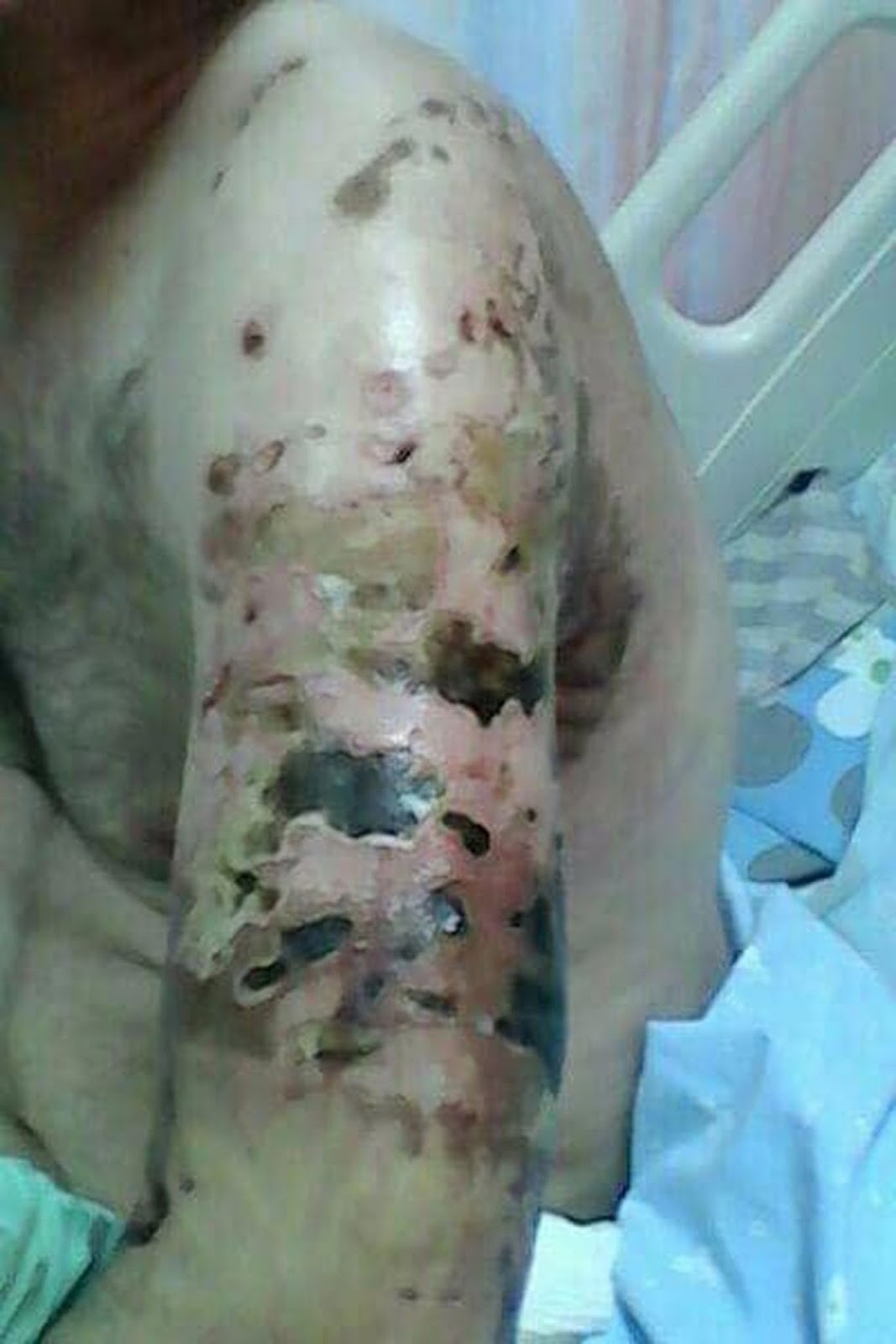 |
| Mabruk Jarrar’s injured arm. Alex Levac |
The dog pounced on Jarrar, fastening its teeth into his left side,
knocking him down and dragging him along the floor. At first the soldiers did
nothing. His wife rushed to him with a blanket, trying to cover the dog with it
and to rescue her husband. The children looked on and cried as their parents
shouted for help; their cries were very loud, they say now. Innas was unable to
free her husband from the dog’s grip.
knocking him down and dragging him along the floor. At first the soldiers did
nothing. His wife rushed to him with a blanket, trying to cover the dog with it
and to rescue her husband. The children looked on and cried as their parents
shouted for help; their cries were very loud, they say now. Innas was unable to
free her husband from the dog’s grip.
It took quite a few minutes, they recall, before the soldiers also tried
to pull the dog off, but the animal didn’t obey them, either. Mabruk was
certain that he was going to be ripped to pieces and die; Innas also feared the
worst.
to pull the dog off, but the animal didn’t obey them, either. Mabruk was
certain that he was going to be ripped to pieces and die; Innas also feared the
worst.
The soldiers tore Jarrar’s clothes off, apparently in an attempt to
release him from the dog’s clutches and finally succeeded – after about a quarter
of an hour, by his estimate. Then one of the soldiers punched him twice in the
face. He was wounded and reeling with fright and in that state, the soldiers
bound his hands behind his back. They took him downstairs, at which point an
officer arrived, asked Jarrar what his name was, released him from the
handcuffs and photographed his injuries. The officer, Jarrar says now, also
seemed to be appalled by the bleeding wounds, the torn and mangled arm and hip.
release him from the dog’s clutches and finally succeeded – after about a quarter
of an hour, by his estimate. Then one of the soldiers punched him twice in the
face. He was wounded and reeling with fright and in that state, the soldiers
bound his hands behind his back. They took him downstairs, at which point an
officer arrived, asked Jarrar what his name was, released him from the
handcuffs and photographed his injuries. The officer, Jarrar says now, also
seemed to be appalled by the bleeding wounds, the torn and mangled arm and hip.
After being handcuffed again, the teacher was taken in a military
vehicle to the detention facility at Salem, near Jenin, where he says he
remained for about three hours with no medical treatment. Finally he was taken
to Haemek Hospital, arriving there at about 10:30 A.M. He was now a detainee,
though it wasn’t clear for what reason.
vehicle to the detention facility at Salem, near Jenin, where he says he
remained for about three hours with no medical treatment. Finally he was taken
to Haemek Hospital, arriving there at about 10:30 A.M. He was now a detainee,
though it wasn’t clear for what reason.
That same night, his two brothers, Mustafa and Mubarak Jarrar, were also
arrested. Mubarak was released; Mustafa remains in custody. They all have the
surname of the person who was wanted for the murder of Rabbi Shevach, Ahmed Jarrar, who was
subsequently killed by the army.
arrested. Mubarak was released; Mustafa remains in custody. They all have the
surname of the person who was wanted for the murder of Rabbi Shevach, Ahmed Jarrar, who was
subsequently killed by the army.
Also on the same night, a similar incident occurred, involving different
IDF forces, in the village of Al-Kfir, near Jenin. At about 4 A.M., soldiers
broke into the home of Samr and Nour Adin Awad, the parents of four small
children. Along with the soldiers, an Oketz dog was brought into the bedroom,
and it bit and wounded both parents.
IDF forces, in the village of Al-Kfir, near Jenin. At about 4 A.M., soldiers
broke into the home of Samr and Nour Adin Awad, the parents of four small
children. Along with the soldiers, an Oketz dog was brought into the bedroom,
and it bit and wounded both parents.
As Nour explained to Abd Al-Karim a-Saadi, a field researcher of the
Israeli B’tselem human rights organization: “I held my 2-year-old son Karem,
who was crying, to my chest. I opened the door, which the soldiers were banging
on, and a dog attacked me, jumping on my chest. Karem fell from my arms. Later
I saw that my husband picked him up from the floor. I tried to push the dog
away after it bit me in the chest. I managed to move it away but then it
grabbed my left hip [with its teeth]. I managed with all my strength to push
him away. At that moment, the soldiers looked at the dog, but did nothing.
During this whole time my husband was begging the soldiers to release the dog
from me. One soldier spoke to the dog in Hebrew and then it grabbed me by the
left arm [holding me] for a few minutes, until a soldier arrived from outside
the house and removed it. I was bleeding and in great pain.”
Israeli B’tselem human rights organization: “I held my 2-year-old son Karem,
who was crying, to my chest. I opened the door, which the soldiers were banging
on, and a dog attacked me, jumping on my chest. Karem fell from my arms. Later
I saw that my husband picked him up from the floor. I tried to push the dog
away after it bit me in the chest. I managed to move it away but then it
grabbed my left hip [with its teeth]. I managed with all my strength to push
him away. At that moment, the soldiers looked at the dog, but did nothing.
During this whole time my husband was begging the soldiers to release the dog
from me. One soldier spoke to the dog in Hebrew and then it grabbed me by the
left arm [holding me] for a few minutes, until a soldier arrived from outside
the house and removed it. I was bleeding and in great pain.”
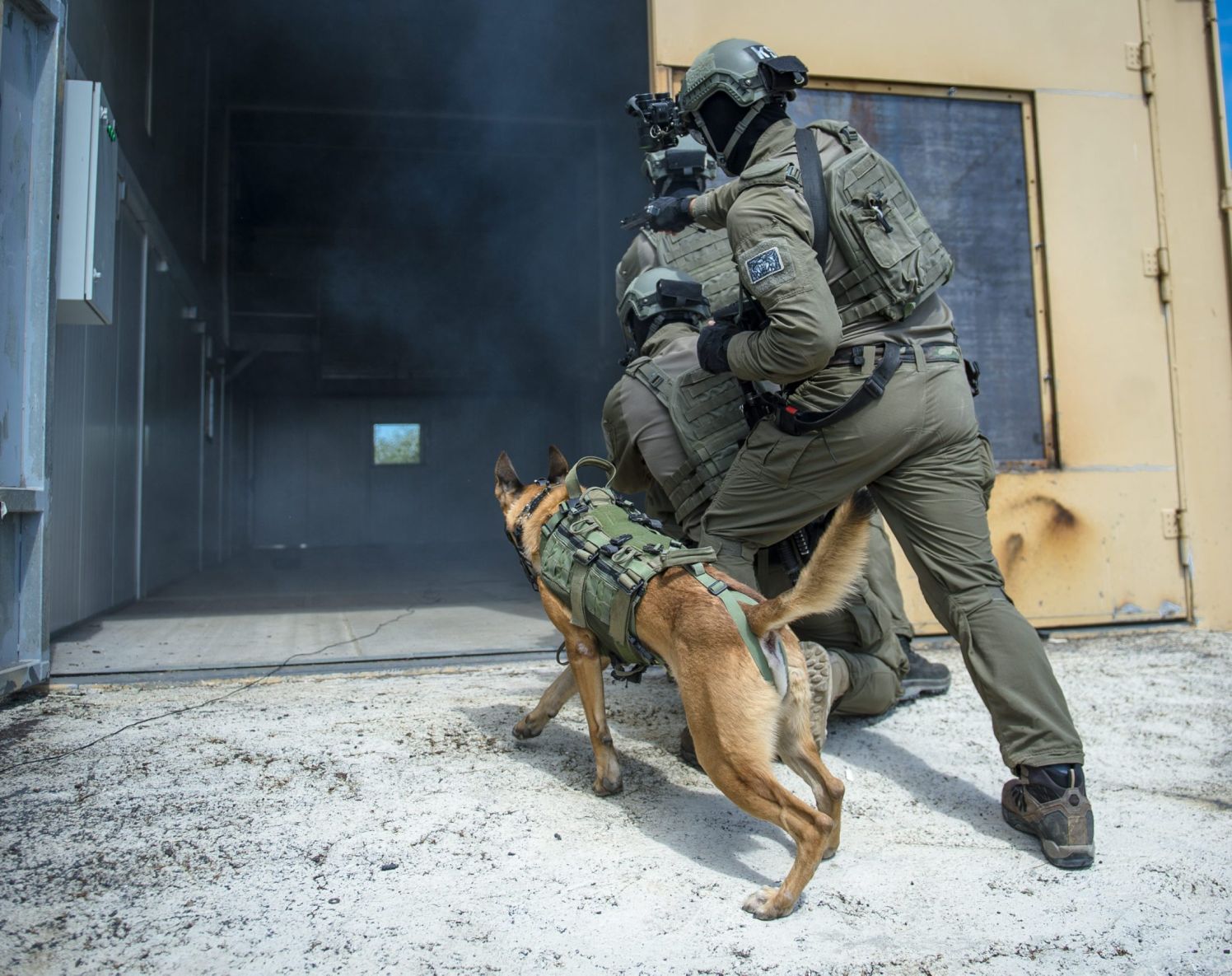 |
| Soldiers from the Israel Defense Forces’ canine unit. Amit Elkayam/IDF Spokesperson’s Unit |
The second intrusion by troops came a few days later, on February 8. Now
only women and children were in the Jarrar house: Innas, her husband’s two
children and also his mother and sister, who live in the same building. It was
3:30 A.M. According to Innas, about 20 soldiers, male and female, took part in
this raid. They told her there was Hamas money in the house and that they had
come to confiscate it. They stepped on the beds and ignored Innas’ pleas to
stop. They asked where Mabruk was – seemingly unaware that he was already in
army custody at the time, in the hospital.
only women and children were in the Jarrar house: Innas, her husband’s two
children and also his mother and sister, who live in the same building. It was
3:30 A.M. According to Innas, about 20 soldiers, male and female, took part in
this raid. They told her there was Hamas money in the house and that they had
come to confiscate it. They stepped on the beds and ignored Innas’ pleas to
stop. They asked where Mabruk was – seemingly unaware that he was already in
army custody at the time, in the hospital.
Then came the body searches. A female soldier took the three women –
Jarrar’s wife, his 75-year-old mother and his 50-year-old disabled sister –
into a room and ordered them to undress completely. The search turned up
nothing: no money, no Hamas. Afterward, the soldiers gave Innas an entry permit
to Israel, to visit her husband in Afula. She says they told her that he was in
Megiddo Prison. She went there the next day, only to discover that he wasn’t
there. She called B’Tselem’s Abed Al-Karim a-Saadi, whom she describes as her
kind redeemer. He made some calls and discovered that Mabruk was actually
hospitalized in Afula. He was still under arrest when she got there, and she
was only allowed to visit him for 45 minutes.
Jarrar’s wife, his 75-year-old mother and his 50-year-old disabled sister –
into a room and ordered them to undress completely. The search turned up
nothing: no money, no Hamas. Afterward, the soldiers gave Innas an entry permit
to Israel, to visit her husband in Afula. She says they told her that he was in
Megiddo Prison. She went there the next day, only to discover that he wasn’t
there. She called B’Tselem’s Abed Al-Karim a-Saadi, whom she describes as her
kind redeemer. He made some calls and discovered that Mabruk was actually
hospitalized in Afula. He was still under arrest when she got there, and she
was only allowed to visit him for 45 minutes.
In response to a request for comment, the IDF Spokesperson’s Unit this
week told Haaretz: “On February 3, 2017, security forces came to the village of
Burkin, to the house of Mabruk Jarrar, who is suspected of activities that
endanger security in Judea and Samaria. Once they were at his home, the troops
called him to come outside. After repeated calls and after he did not come out,
the forces acted according to procedure and a dog was sent to search for people
inside. The suspect had locked himself in a room on the upper floor of the
building together with female members of his family.
week told Haaretz: “On February 3, 2017, security forces came to the village of
Burkin, to the house of Mabruk Jarrar, who is suspected of activities that
endanger security in Judea and Samaria. Once they were at his home, the troops
called him to come outside. After repeated calls and after he did not come out,
the forces acted according to procedure and a dog was sent to search for people
inside. The suspect had locked himself in a room on the upper floor of the
building together with female members of his family.
“When the door opened, the dog bit the suspect, injuring him. He
received immediate assistance from the army’s medical forces until he was evacuated
to the hospital. Thereafter other activities were conducted in search of wanted
individuals. We stress that in contrast with what is claimed in the article,
the women of the house were not stripped by army forces.”
received immediate assistance from the army’s medical forces until he was evacuated
to the hospital. Thereafter other activities were conducted in search of wanted
individuals. We stress that in contrast with what is claimed in the article,
the women of the house were not stripped by army forces.”
Jarrar is sitting on his hospital bed, his speech strained, every
movement an effort. Innas arrives every day from Burkin. “How do you think I
felt?” he replies in answer to a question about what he felt during the dog’s
attack. “I thought I was going to die.”
movement an effort. Innas arrives every day from Burkin. “How do you think I
felt?” he replies in answer to a question about what he felt during the dog’s
attack. “I thought I was going to die.”
Given the ethnic composition of the physicians, patients, nurses and
visitors, this is effectively a binational Jewish-Arab hospital – like most of
the hospitals in the north of the country. But a Jewish maintenance man
suddenly enters the room, seething with anger. “Why are you interviewing Arabs? Why not Jews?” he demands. The man threatens to summon the hospital’s security
officer, because wounded, mauled Mabruk Jarrar was talking to us.
visitors, this is effectively a binational Jewish-Arab hospital – like most of
the hospitals in the north of the country. But a Jewish maintenance man
suddenly enters the room, seething with anger. “Why are you interviewing Arabs? Why not Jews?” he demands. The man threatens to summon the hospital’s security
officer, because wounded, mauled Mabruk Jarrar was talking to us.
Palestinian
victim sues Dutch supplier of Israeli attack dogs
Adri
Nieuwhof 15 February 2018
A Palestinian from the occupied West Bank is suing the Dutch company that
supplied the dogs Israeli soldiers used to attack him when he was a child.
For more than 20 years, Four Winds K9, a company based near the city
of Nijmegen, has annually provided the Israeli army with dozens of dogs
trained to attack civilians.
of Nijmegen, has annually provided the Israeli army with dozens of dogs
trained to attack civilians.
The military dogs “are intentionally used by Israeli occupying
forces to terrorize and bite Palestinian civilians, especially during protests
and night house raids,” according
to Shawan Jabarin, director of the human rights group Al-Haq.
forces to terrorize and bite Palestinian civilians, especially during protests
and night house raids,” according
to Shawan Jabarin, director of the human rights group Al-Haq.
This cruel tactic is reminiscent of how police in the United States
and apartheid South Africa set attack dogs on Black citizens demanding their
rights.
and apartheid South Africa set attack dogs on Black citizens demanding their
rights.
“Biting dogs”
In 2015, Four
Winds K9 co-owner Tonny Boeijen boasted
in the newspaper NRC that 90 percent of the dogs
used by the Israeli military were trained by his company.
Winds K9 co-owner Tonny Boeijen boasted
in the newspaper NRC that 90 percent of the dogs
used by the Israeli military were trained by his company.
Lawmakers called on Lilian Ploumen, the Dutch trade minister at that
time, to halt the export of the dogs.
time, to halt the export of the dogs.
Ploumen said
she wanted to end the trade as well but saw no legal basis for a ban.
she wanted to end the trade as well but saw no legal basis for a ban.
Instead, Ploumen engaged with Four Winds K9, urging the company to
respect the UN
Guiding Principles on Business and Human Rights in conflict zones.
respect the UN
Guiding Principles on Business and Human Rights in conflict zones.
As a result, the company announced
in June 2016 that it was no longer providing Israel with “biting dogs,” but
only tracking hounds.
in June 2016 that it was no longer providing Israel with “biting dogs,” but
only tracking hounds.
“We had no intention to violate human rights,” company co-owner
Linda Boeijen told NRC.
Linda Boeijen told NRC.
“Give it to him, son of a bitch”
But that was not the end of the story.
Hamzeh Abu Hashem, a Palestinian victim of two Dutch attack dogs,
filed a civil lawsuit against Four Winds K9 and its directors in the
Netherlands last December.
filed a civil lawsuit against Four Winds K9 and its directors in the
Netherlands last December.
On 23 December 2014, Abu Hashem, then 16, was attacked by two
Israeli army dogs and suffered serious injuries.
Israeli army dogs and suffered serious injuries.
There had been confrontations between Israeli occupation forces and
residents of Abu Hashem’s village of Beit Ommar in an area
where Palestinian youths frequently protested the seizure
of the village’s land for the nearby settlement of Karmei Tzur.
residents of Abu Hashem’s village of Beit Ommar in an area
where Palestinian youths frequently protested the seizure
of the village’s land for the nearby settlement of Karmei Tzur.
According to a brief by Liesbeth Zegveld and Lisa Komp, attorneys
with human rights law firm Prakken d’Oliveira who are representing Abu Hashem,
Israeli soldiers arrived with two canines and unleashed them on the youths.
with human rights law firm Prakken d’Oliveira who are representing Abu Hashem,
Israeli soldiers arrived with two canines and unleashed them on the youths.
The dogs chased Abu Hashem and grabbed him in a yard between two
houses. In an attack caught on video, the dogs bit him multiple times in his
legs, arms and shoulder.
houses. In an attack caught on video, the dogs bit him multiple times in his
legs, arms and shoulder.
“These camera images show that Israeli soldiers initially stood by
taunting Hamzeh while watching the dogs bite him and hearing him scream in
agony,” the brief states.
taunting Hamzeh while watching the dogs bite him and hearing him scream in
agony,” the brief states.
The video is at the top of this article.
After Hamzeh was bitten multiple times, the dogs were finally pulled
off him and he was arrested by the soldiers.
off him and he was arrested by the soldiers.
The video of the incident filmed by one of the soldiers and published
by the human rights group B’Tselem shows the child crying out in pain while
the soldiers can be heard shouting, “give it to him, son of a bitch” and “who’s
afraid?”
by the human rights group B’Tselem shows the child crying out in pain while
the soldiers can be heard shouting, “give it to him, son of a bitch” and “who’s
afraid?”
According to B’Tselem, Michael Ben-Ari,
a right-wing former Israeli lawmaker, had posted the video on Facebook.
a right-wing former Israeli lawmaker, had posted the video on Facebook.
A summons filed by Abu Hashem’s lawyers states that Ben-Ari wrote on
Facebook, “The soldiers taught the little terrorist a lesson.”
Facebook, “The soldiers taught the little terrorist a lesson.”
The summons notes that after watching video of the attack, director
Tonny Boeijen confirmed
to NRC in
2015 that the dogs were supplied by his company.
Tonny Boeijen confirmed
to NRC in
2015 that the dogs were supplied by his company.
Company’s responsibility
Abu Hashem’s lawyers argue that Four Winds K9 acted wrongfully
towards him.
towards him.
They say the company knew or should have known that dog attacks in the
occupied West Bank are part of a settled practice: The Israeli army regularly
unleashed its dogs against Palestinian civilians.
occupied West Bank are part of a settled practice: The Israeli army regularly
unleashed its dogs against Palestinian civilians.
They argue that the dog attacks breach Israel’s obligations under
the Fourth Geneva Convention to protect civilians in occupied territory.
the Fourth Geneva Convention to protect civilians in occupied territory.
According to the lawyers’ brief, the dogs supplied by Four Winds K9
enable Israel “to enforce its authority over the Palestinian territories, and
to continue its policy of unlawful Israeli settlements.”
enable Israel “to enforce its authority over the Palestinian territories, and
to continue its policy of unlawful Israeli settlements.”
The lawsuit demands damages for Abu Hashem and that the Dutch firm
be prohibited from supplying dogs to the Israeli army.
be prohibited from supplying dogs to the Israeli army.
Four Winds K9 claims that only the Israeli army is responsible for
the damage caused by the use of the dogs.
the damage caused by the use of the dogs.
But Abu Hashem’s lawyers respond that the company has an “independent
duty of care” to ensure that it does not contribute to injuring Abu Hashem or
to maintaining “a situation in breach of international humanitarian law and
fundamental human rights.”
duty of care” to ensure that it does not contribute to injuring Abu Hashem or
to maintaining “a situation in breach of international humanitarian law and
fundamental human rights.”
The company also argues that the export of the dogs did not violate any
specific laws or regulations, and therefore it cannot be liable.
specific laws or regulations, and therefore it cannot be liable.
The lawyers counter that its conduct would still violate “what
according to unwritten law has to be regarded as proper social conduct” as
defined in the Dutch civil code.
according to unwritten law has to be regarded as proper social conduct” as
defined in the Dutch civil code.
The lawsuit against Four Winds K9 sets a clear example that
companies involved in Israel’s violations of international law and Palestinian
human rights can be held accountable.
companies involved in Israel’s violations of international law and Palestinian
human rights can be held accountable.
Posted in Blog
