
According to Liberty’s Olivia Percival, ‘Liberty is not actively campaigning against the IHRA definition’

Liberty,
formerly known as the National Council for Civil Liberties,
was founded in 1934. This was a time of heightened anti-fascist activity in which
the Jews of the East End of London were under attack from Oswald Moseley’s British
Union of Fascists. In 1989 the
organisation changed its name to Liberty.
The
organisation has provided a career path for budding Labour politicians such as Patricia
Hewitt, who went on to become an MP and in charge of Neil Kinnock’s personal
office before being brought down by the cash for influence scandal. Harriet Harman was a former legal officer and
her husband Jack Dromey was Chair of the Executive Committee. Shami Chakrabarti
the previous Director is now Shadow Attorney General. What all the ex-employees
of Liberty who find their way to the top of the Labour Party have in common is their
abandoning and jettisoning of any pretence of support for civil liberties. Harriet Harman for example went along with
all Tony Blair’s anti-terrorism legislation without a squeak. Chakrabarti’s
attack on Ken Livingstone suggests that she too considers civil liberties to be
a drag on her career.
organisation has provided a career path for budding Labour politicians such as Patricia
Hewitt, who went on to become an MP and in charge of Neil Kinnock’s personal
office before being brought down by the cash for influence scandal. Harriet Harman was a former legal officer and
her husband Jack Dromey was Chair of the Executive Committee. Shami Chakrabarti
the previous Director is now Shadow Attorney General. What all the ex-employees
of Liberty who find their way to the top of the Labour Party have in common is their
abandoning and jettisoning of any pretence of support for civil liberties. Harriet Harman for example went along with
all Tony Blair’s anti-terrorism legislation without a squeak. Chakrabarti’s
attack on Ken Livingstone suggests that she too considers civil liberties to be
a drag on her career.
 |
| Martha Spurrier, another in a long line of hopeful Establishment Labour politicians |
The
current Director, Martha Spurrier is, like her predecessor, a barrister. Liberty/NCCL
has never been a particular radical organisation, especially in recent times. In
its earlier times it had no difficulty supporting for example the internment of
Oswald Moseley in the war, something which led to mass resignations from the
organisation.
current Director, Martha Spurrier is, like her predecessor, a barrister. Liberty/NCCL
has never been a particular radical organisation, especially in recent times. In
its earlier times it had no difficulty supporting for example the internment of
Oswald Moseley in the war, something which led to mass resignations from the
organisation.
During
the period of Hewitt and Harman the organisation adopted a policy which was in
effect pro-paedophile. The Paedophile Information Exchange became affiliated at
one point and it was only in 1983 that the organisation rejected paedophilia as
just another sexual life style. All that can be said about this period is that paedophile
groups were able to take advantage of the sexual revolution of the 1960’s to propagate
the idea that sexual freedom should include the right of adults to have sex
with children and that this found favour amongst a section of the libertarian
left and gay rights campaigners such as Peter Tatchell.
the period of Hewitt and Harman the organisation adopted a policy which was in
effect pro-paedophile. The Paedophile Information Exchange became affiliated at
one point and it was only in 1983 that the organisation rejected paedophilia as
just another sexual life style. All that can be said about this period is that paedophile
groups were able to take advantage of the sexual revolution of the 1960’s to propagate
the idea that sexual freedom should include the right of adults to have sex
with children and that this found favour amongst a section of the libertarian
left and gay rights campaigners such as Peter Tatchell.
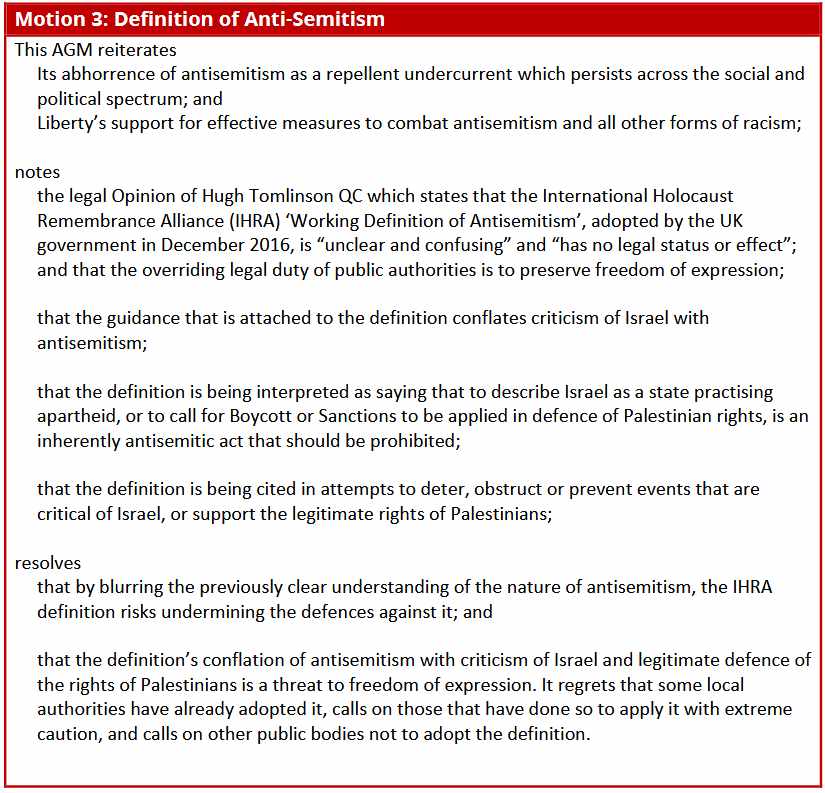
Liberty/NCCL
has always seen itself as part of the British Establishment. It is therefore no
surprise that when Professor Jonathan Rosenhead of the LSE moved a motion at the
May 2018 AGM, seconded by Louise Christian, a well known solicitor, opposing
the International Holocaust Remembrance Alliance definition of anti-Semitism, its
officers took fright. The motion itself was passed almost unanimously.
has always seen itself as part of the British Establishment. It is therefore no
surprise that when Professor Jonathan Rosenhead of the LSE moved a motion at the
May 2018 AGM, seconded by Louise Christian, a well known solicitor, opposing
the International Holocaust Remembrance Alliance definition of anti-Semitism, its
officers took fright. The motion itself was passed almost unanimously.
The
IHRA is a consensus position of the British political establishment and Liberty
is, if nothing else, an establishment group. When I heard that the motion had
been passed I wrote to Liberty inquiring about their new policy. I heard nothing for some months.
IHRA is a consensus position of the British political establishment and Liberty
is, if nothing else, an establishment group. When I heard that the motion had
been passed I wrote to Liberty inquiring about their new policy. I heard nothing for some months.

I
had quite forgotten about my inquiry until an email arrived from Olivia
Percival, a former government solicitor who is now Liberty’s Advice &
Information Officer. As I read the email I became more and more disconcerted.
Ms Percival did not have one good thing to say about Liberty’s policy. What she
seemed to be doing was to explain why the organisation was doing nothing about
the organisation.
had quite forgotten about my inquiry until an email arrived from Olivia
Percival, a former government solicitor who is now Liberty’s Advice &
Information Officer. As I read the email I became more and more disconcerted.
Ms Percival did not have one good thing to say about Liberty’s policy. What she
seemed to be doing was to explain why the organisation was doing nothing about
the organisation.
Percival
first began by telling me that ‘I would
emphasise that the motion reaffirmed Liberty’s opposition to anti-semitism in
all its forms’. The implication being that opposition to the IHRA might be
construed as support for anti-Semitism!
first began by telling me that ‘I would
emphasise that the motion reaffirmed Liberty’s opposition to anti-semitism in
all its forms’. The implication being that opposition to the IHRA might be
construed as support for anti-Semitism!

It
was the next paragraph that left me open mouthed. It would appear that
Percival, who is clearly not stupid, deliberately didn’t want to understand the
reason for opposition to the IHRA: She wrote that:
was the next paragraph that left me open mouthed. It would appear that
Percival, who is clearly not stupid, deliberately didn’t want to understand the
reason for opposition to the IHRA: She wrote that:
‘As
an organisation that both fervently supports free speech and fervently opposes
anti-semitism, Liberty has an obligation to carefully consider the intersection
of these two issues. Whenever we talk about hate speech, we immediately have to
think about the boundaries of free speech. Drawing that boundary is not always
easy. The position Liberty has taken on the IHRA definition comes from a good
faith effort to think through this issue.
an organisation that both fervently supports free speech and fervently opposes
anti-semitism, Liberty has an obligation to carefully consider the intersection
of these two issues. Whenever we talk about hate speech, we immediately have to
think about the boundaries of free speech. Drawing that boundary is not always
easy. The position Liberty has taken on the IHRA definition comes from a good
faith effort to think through this issue.
The
clear implication being that opposition to the IHRA meant support for anti-Semitic
hate speech. Why else would she talk about the ‘intersection’ of the two issues of free speech and anti-Semitism?
clear implication being that opposition to the IHRA meant support for anti-Semitic
hate speech. Why else would she talk about the ‘intersection’ of the two issues of free speech and anti-Semitism?
What
Percival was doing was to revisit the policy of Liberty’s American equivalent,
the American Civil Liberties Union which infamously
supported a march through the Skokie in Chicago, where large numbers of Holocaust
survivors lived, by the American Nazi Party. See the NYT, July 1978 THE
A.C.L.U. AGAINST ITSELF.
Percival was doing was to revisit the policy of Liberty’s American equivalent,
the American Civil Liberties Union which infamously
supported a march through the Skokie in Chicago, where large numbers of Holocaust
survivors lived, by the American Nazi Party. See the NYT, July 1978 THE
A.C.L.U. AGAINST ITSELF.
 |
| Olivia Percival’s email to Tony Greenstein |
Thousands
of Jews and others left the ACLU over their support for the right of neo-Nazis
to propagate their filth and hatred. Indeed this controversy briefly surfaced
in the NCCL when its American Director, Andrew
Puddephat I believe, argued for the freedom of speech of fascists in this
country. It sparked a heated controversy within the NCCL which led to his
departure.
of Jews and others left the ACLU over their support for the right of neo-Nazis
to propagate their filth and hatred. Indeed this controversy briefly surfaced
in the NCCL when its American Director, Andrew
Puddephat I believe, argued for the freedom of speech of fascists in this
country. It sparked a heated controversy within the NCCL which led to his
departure.
Percival
however has completely misunderstood the nature of the opposition to the IHRA,
some would say deliberately so. Jonathan Rosenhead is himself Jewish. Neither
he nor Jewish Voice for Labour of which he is a member support free speech for anti-Semites.
Opposition to the IHRA has nothing to do with support for free speech for
racists and fascists. There may indeed be an interesting discussion about ‘the boundaries of free speech’ when it
comes to hate speech but it has nothing to do with the IHRA and it is dishonest
for Percival to suggest otherwise.
however has completely misunderstood the nature of the opposition to the IHRA,
some would say deliberately so. Jonathan Rosenhead is himself Jewish. Neither
he nor Jewish Voice for Labour of which he is a member support free speech for anti-Semites.
Opposition to the IHRA has nothing to do with support for free speech for
racists and fascists. There may indeed be an interesting discussion about ‘the boundaries of free speech’ when it
comes to hate speech but it has nothing to do with the IHRA and it is dishonest
for Percival to suggest otherwise.
Opposition
to the IHRA is about opposition to the attack on the rights of supporters of
the Palestinians and anti-Zionists to oppose Israeli Apartheid. It has nothing
to do with supporting the rights of anti-Semites. It is disingenuous to suggest
this.
to the IHRA is about opposition to the attack on the rights of supporters of
the Palestinians and anti-Zionists to oppose Israeli Apartheid. It has nothing
to do with supporting the rights of anti-Semites. It is disingenuous to suggest
this.
 |
| The American ACLU defended the rights of Nazis in Skokie, Chicag- pictured is a Vietnam veteran |
If
Olivia Percival had bothered to read the resolution which was passed she would
know that it begins by reiterating its ‘abhorrence
of antisemitism as a repellent undercurrent..’ Even this well-heeled former
government solicitor should be aware that some of the most vigorous supporters
of Israel, Zionism and the IHRA are also some of the most notorious racist bigots
in politics. Donald Trump combines
ardent support for Israel with anti-Semitism. His election campaign was widely
condemned by American Jews for its use of anti-semitic stereotypes and
subliminal messages. See Anti-Semitism
is no longer an undertone of Trump’s campaign. It’s the melody.
Olivia Percival had bothered to read the resolution which was passed she would
know that it begins by reiterating its ‘abhorrence
of antisemitism as a repellent undercurrent..’ Even this well-heeled former
government solicitor should be aware that some of the most vigorous supporters
of Israel, Zionism and the IHRA are also some of the most notorious racist bigots
in politics. Donald Trump combines
ardent support for Israel with anti-Semitism. His election campaign was widely
condemned by American Jews for its use of anti-semitic stereotypes and
subliminal messages. See Anti-Semitism
is no longer an undertone of Trump’s campaign. It’s the melody.
The
person who masterminded Trump’s campaign, Steve Bannon, is personally anti-Semitic
and a supporter of the European far-Right and Tommy Robinson. The founder of
the American alt-Right, the neo-Nazi Richard Spencer has even declared that he
is a White
Zionist
person who masterminded Trump’s campaign, Steve Bannon, is personally anti-Semitic
and a supporter of the European far-Right and Tommy Robinson. The founder of
the American alt-Right, the neo-Nazi Richard Spencer has even declared that he
is a White
Zionist
The
policy passed by Liberty in opposition to the IHRA has nothing whatsoever to do
with support for anti-Semitism or anti-Semitic hate speech. What it does do is
support freedom of speech for opponents of Israeli apartheid. It is dishonest of
Percival to suggest otherwise.
policy passed by Liberty in opposition to the IHRA has nothing whatsoever to do
with support for anti-Semitism or anti-Semitic hate speech. What it does do is
support freedom of speech for opponents of Israeli apartheid. It is dishonest of
Percival to suggest otherwise.
And
to add insult to injury, this establishment lawyer that Liberty has taken under
its wing goes on to state that ‘We have been
very clear that Liberty is not actively campaigning against the IHRA
definition, as it is not an institutional priority.’ That is obvious
because there is not one single mention of the IHRA on Liberty’s website.
to add insult to injury, this establishment lawyer that Liberty has taken under
its wing goes on to state that ‘We have been
very clear that Liberty is not actively campaigning against the IHRA
definition, as it is not an institutional priority.’ That is obvious
because there is not one single mention of the IHRA on Liberty’s website.
At a time
when right-wing Labour Councils are adopting the IHRA, in consort with Tory councillors,
with the specific intention of curtailing the rights of Palestine solidarity
supporters, Liberty under its present leadership chooses to ignore its own
policy and do nothing.
when right-wing Labour Councils are adopting the IHRA, in consort with Tory councillors,
with the specific intention of curtailing the rights of Palestine solidarity
supporters, Liberty under its present leadership chooses to ignore its own
policy and do nothing.
As if to emphasise her own
disagreement with the policy Percival writes that
disagreement with the policy Percival writes that
‘it’s
often the case that members (and even sometimes our staff!) disagree with some
of the organisation’s positions but remain engaged in an overall common
purpose, and even work from within the organisation to change it.
often the case that members (and even sometimes our staff!) disagree with some
of the organisation’s positions but remain engaged in an overall common
purpose, and even work from within the organisation to change it.
Whilst no
one expects staff to agree with every resolution, it is nonetheless their duty
to give implement policy passed. The IHRA is being pushed hard by the present
Conservative government, a government which is aligned in the European Parliament
with far-Right anti-Semitic parties. The
IHRA is being used on campuses to prevent or seriously hinder Palestine solidarity
campaigns.
one expects staff to agree with every resolution, it is nonetheless their duty
to give implement policy passed. The IHRA is being pushed hard by the present
Conservative government, a government which is aligned in the European Parliament
with far-Right anti-Semitic parties. The
IHRA is being used on campuses to prevent or seriously hinder Palestine solidarity
campaigns.
Even the principal author of the IHRA or the Working
Definition of Anti-Semitism, the American Jewish Committee’s Kenneth Stern
has acknowledged that the IHRA is being used in ways that were never intended,
as a means of chilling free speech. In testimony to the House of Representatives in November 2017, he warned
that:
Definition of Anti-Semitism, the American Jewish Committee’s Kenneth Stern
has acknowledged that the IHRA is being used in ways that were never intended,
as a means of chilling free speech. In testimony to the House of Representatives in November 2017, he warned
that:
The definition was not drafted, and was never intended, as a
tool to target or chill speech on a college campus. In fact, at a conference in
2010 about the impact of the definition, I highlighted this misuse, and the
damage it could do.
tool to target or chill speech on a college campus. In fact, at a conference in
2010 about the impact of the definition, I highlighted this misuse, and the
damage it could do.
Stern spoke
about how the IHRA was ‘was being employed in an attempt to restrict
academic freedom and punish political speech’. One could argue that Stern
was being hypocritical since the IHRA’s whole purpose was to render
anti-Zionist criticism as antisemitic.
about how the IHRA was ‘was being employed in an attempt to restrict
academic freedom and punish political speech’. One could argue that Stern
was being hypocritical since the IHRA’s whole purpose was to render
anti-Zionist criticism as antisemitic.
Stern described how Zionist pressure groups in
the US ‘argued that even if the [court] cases lost, they had what seemed
to them a positive benefit – they chilled
pro -Palestinian expression.’
Stern asked a question particularly relevant to the current debate.
the US ‘argued that even if the [court] cases lost, they had what seemed
to them a positive benefit – they chilled
pro -Palestinian expression.’
Stern asked a question particularly relevant to the current debate.
‘Imagine a definition designed for
Palestinians. If “Denying the Jewish
people their right to self- determination, and denying Israel the right to
exist” is antisemitism, then shouldn’t “Denying
the Palestinian people their right to self- determination, and denying Palestine the right to exist” be anti -Palestinianism?’
Palestinians. If “Denying the Jewish
people their right to self- determination, and denying Israel the right to
exist” is antisemitism, then shouldn’t “Denying
the Palestinian people their right to self- determination, and denying Palestine the right to exist” be anti -Palestinianism?’
Stern described how the IHRA had been used to
curtail free speech in Britain, listing the “Israel Apartheid Week” event which
was cancelled by Central Lancashire University and the case of the Holocaust
survivor who was required to change the title of a campus talk by Manchester university after
an Israeli diplomat complained that the title violated the definition.’ Stern described as ‘Perhaps most
egregious’ of all the call on a university to conduct an inquiry of a professor for ‘antisemitism’, based on an
article she had written years before. Accurately describing what had happened
as ‘chilling and McCarthy -like.’
curtail free speech in Britain, listing the “Israel Apartheid Week” event which
was cancelled by Central Lancashire University and the case of the Holocaust
survivor who was required to change the title of a campus talk by Manchester university after
an Israeli diplomat complained that the title violated the definition.’ Stern described as ‘Perhaps most
egregious’ of all the call on a university to conduct an inquiry of a professor for ‘antisemitism’, based on an
article she had written years before. Accurately describing what had happened
as ‘chilling and McCarthy -like.’
As Jewish student
Joanna Phillips wrote
in Jewish News/Times of Israel ‘Jewish
students deserve a better definition of anti-Semitism’
Joanna Phillips wrote
in Jewish News/Times of Israel ‘Jewish
students deserve a better definition of anti-Semitism’
Kenneth Stern … went as far as to write to the US
House of Representatives urging them not to adopt this definition for American
campuses. Jewish students need a tailored definition, written with the
realities of modern universities in mind, not one designed for researchers.
House of Representatives urging them not to adopt this definition for American
campuses. Jewish students need a tailored definition, written with the
realities of modern universities in mind, not one designed for researchers.
Stern was prompted to write his letter after seeing the waves of
censorship the definition unleashed within American campuses. The IHRA
definition fails to properly distinguish between legitimate criticism of Israel
and hatred of Jews disguised as anti-Zionism.
censorship the definition unleashed within American campuses. The IHRA
definition fails to properly distinguish between legitimate criticism of Israel
and hatred of Jews disguised as anti-Zionism.
It would seem that Olivia Percival and Martha
Spurrier, to whom I have written, also have difficulty distinguishing between anti-Semitism
and criticism of Israel and Zionism. If Percival
and Spurrier refuse to implement Liberty policy on the IHRA then they have no
alternative but to resign. Freedom of
speech on university campuses and on Palestine is not a peripheral issue.
Spurrier, to whom I have written, also have difficulty distinguishing between anti-Semitism
and criticism of Israel and Zionism. If Percival
and Spurrier refuse to implement Liberty policy on the IHRA then they have no
alternative but to resign. Freedom of
speech on university campuses and on Palestine is not a peripheral issue.
Below is my letter to Ms Percival and the
policy that Liberty has adopted.
policy that Liberty has adopted.
Tony Greenstein
Letter of Reply to Olivia Percival
Dear Olivia,
Thank you for your email
of 2nd October concerning the decision of the Liberty AGM to oppose
the International Holocaust Remembrance Alliance
definition of anti-Semitism. I am surprised that you sent this from a ‘noreply’ email address. That is what my broadband supplier does. It
indicates that you don’t wish to enter into dialogue on this subject. I have
therefore dug out an email address for your Director and may post this more
widely given your reluctance to be more open.
of 2nd October concerning the decision of the Liberty AGM to oppose
the International Holocaust Remembrance Alliance
definition of anti-Semitism. I am surprised that you sent this from a ‘noreply’ email address. That is what my broadband supplier does. It
indicates that you don’t wish to enter into dialogue on this subject. I have
therefore dug out an email address for your Director and may post this more
widely given your reluctance to be more open.
I am extremely
disappointed by your response, which is almost apologetic for the fact that the
motion was passed. Why else would you emphasise that members ‘and even sometimes our staff! disagree with
some of the organisation’s positions’.
This strongly suggests that you intend to do your best to ignore the
motion and do nothing about it. It also suggests that you disagree with the
policy.
disappointed by your response, which is almost apologetic for the fact that the
motion was passed. Why else would you emphasise that members ‘and even sometimes our staff! disagree with
some of the organisation’s positions’.
This strongly suggests that you intend to do your best to ignore the
motion and do nothing about it. It also suggests that you disagree with the
policy.
What is the purpose of
passing policy at Liberty’s AGM if you and the staff immediately disregard it?
The IHRA has already been used in this country to prevent an Israeli Apartheid
Week at the University of Central Lancashire, to prevent Professor Richard Falk
speaking on campuses and to impose restrictions on other pro-Palestinian events.
Even the person who drafted the IHRA, Kenneth Stern, in testimony to the House of Representatives last November warned that:
passing policy at Liberty’s AGM if you and the staff immediately disregard it?
The IHRA has already been used in this country to prevent an Israeli Apartheid
Week at the University of Central Lancashire, to prevent Professor Richard Falk
speaking on campuses and to impose restrictions on other pro-Palestinian events.
Even the person who drafted the IHRA, Kenneth Stern, in testimony to the House of Representatives last November warned that:
‘The definition was not drafted, and was never
intended, as a tool to target or chill speech on a college campus. In fact, at
a conference in 2010 about the impact of the definition, I highlighted this
misuse, and the damage it could do.’
intended, as a tool to target or chill speech on a college campus. In fact, at
a conference in 2010 about the impact of the definition, I highlighted this
misuse, and the damage it could do.’
I find particularly
surprising your point that Liberty ‘both
fervently supports free speech and fervently opposes anti-Semitism’ as if
opposition to the IHRA means support for anti-Semitism. Viktor Orban, Hungary’s
anti-Semitic Prime Minister certainly doesn’t share this position as his
government fully supports the IHRA whilst lauding its war-time pro-Nazi ruler
Admiral Horthy. You clearly do not understand why many people oppose both the
IHRA and oppose racism and anti-Semitism.
surprising your point that Liberty ‘both
fervently supports free speech and fervently opposes anti-Semitism’ as if
opposition to the IHRA means support for anti-Semitism. Viktor Orban, Hungary’s
anti-Semitic Prime Minister certainly doesn’t share this position as his
government fully supports the IHRA whilst lauding its war-time pro-Nazi ruler
Admiral Horthy. You clearly do not understand why many people oppose both the
IHRA and oppose racism and anti-Semitism.
Of the 8, yes 8,
governments that have fully adopted the definition, (Macedonia, Bulgaria, Romania,
Lithuania, Austria) 5
possess far-Right governments and one, Austria has a neo-Nazi party Heinz
Christian Strache’s Freedom Party as the junior coalition partner.
governments that have fully adopted the definition, (Macedonia, Bulgaria, Romania,
Lithuania, Austria) 5
possess far-Right governments and one, Austria has a neo-Nazi party Heinz
Christian Strache’s Freedom Party as the junior coalition partner.
You speak about the ‘intersection’ of free speech and
opposition to anti-Semitism with talk about the ‘boundaries of free speech.’ You seem to be labouring under the
misapprehension that opposition to the IHRA has something to do with free
speech for anti-Semites or racists. Let
me disabuse you of this fact.
opposition to anti-Semitism with talk about the ‘boundaries of free speech.’ You seem to be labouring under the
misapprehension that opposition to the IHRA has something to do with free
speech for anti-Semites or racists. Let
me disabuse you of this fact.
The IHRA ‘definition’ of
anti-Semitism has nothing to do with opposing anti-Semitism and
everything to do with conflating opposition to Zionism and support for the
Palestinians with anti-Semitism. The IHRA is about defining critics of Israeli
Apartheid as anti-Semitic. The demolition of Arab villages to make way for
Jewish settlements and towns is inherent in what a Jewish State means. According to the IHRA to make this point is
anti-Semitic and you appear to go along with this nonsense.
anti-Semitism has nothing to do with opposing anti-Semitism and
everything to do with conflating opposition to Zionism and support for the
Palestinians with anti-Semitism. The IHRA is about defining critics of Israeli
Apartheid as anti-Semitic. The demolition of Arab villages to make way for
Jewish settlements and towns is inherent in what a Jewish State means. According to the IHRA to make this point is
anti-Semitic and you appear to go along with this nonsense.
I find it disappointing
that you haven’t grasped this elementary fact. Clearly you haven’t acquainted
yourself with recent debates around the IHRA. Perhaps I can apprise you of
them?
that you haven’t grasped this elementary fact. Clearly you haven’t acquainted
yourself with recent debates around the IHRA. Perhaps I can apprise you of
them?
Professor David Feldman, who was Vice-Chair of the Chakrabarti Inquiry and
is Director of the Pears Institute for
the Study of Anti-Semitism described the IHRA definition as‘bewilderingly imprecise.’ with its talk of anti-Semitism being a ‘certain
perception which might be expressed as anti-Semitism’.
is Director of the Pears Institute for
the Study of Anti-Semitism described the IHRA definition as‘bewilderingly imprecise.’ with its talk of anti-Semitism being a ‘certain
perception which might be expressed as anti-Semitism’.
Sir Stephen Sedley, who was a Judge in the Court of Appeal, besides
being Jewish, wrote, in Defining Anti-Semitism that the IHRA‘fails
the first test of any definition: it is indefinite.’ In what is the most
concise critique of the IHRA yet, Sedley took it apart for its deliberate
attempt to prevent any systematic critique of the Israeli state and Zionism.
being Jewish, wrote, in Defining Anti-Semitism that the IHRA‘fails
the first test of any definition: it is indefinite.’ In what is the most
concise critique of the IHRA yet, Sedley took it apart for its deliberate
attempt to prevent any systematic critique of the Israeli state and Zionism.
Hugh Tomlinson QC in an Opinion declared, as did other lawyers, that the IHRA had a ‘potential chilling effect on public bodies
which, in the absence of definitional clarity, may seek to sanction or prohibit
any conduct which has been labelled by third parties as antisemitic without
applying any clear criterion of assessment.’
which, in the absence of definitional clarity, may seek to sanction or prohibit
any conduct which has been labelled by third parties as antisemitic without
applying any clear criterion of assessment.’
Geoffrey Robertson QC, who is a
renowned human rights lawyer likewise described the IHRA as likely to chill criticism of action by the
Government of Israel and advocacy of sanctions as a means to deter human rights
abuses in Gaza and elsewhere. Robertson described the IHRA as ‘not fit
for purpose’
renowned human rights lawyer likewise described the IHRA as likely to chill criticism of action by the
Government of Israel and advocacy of sanctions as a means to deter human rights
abuses in Gaza and elsewhere. Robertson described the IHRA as ‘not fit
for purpose’
Interestingly Robertson also finds, along with Sedley, that when it
comes to genuine anti-Semitism, the IHRA actually raises the bar because
‘By
pivoting upon racial hatred … it fails to catch those who exhibit hostility and
prejudice – or apply discrimination – against Jewish people for no reason other
than that they are Jewish.’
comes to genuine anti-Semitism, the IHRA actually raises the bar because
‘By
pivoting upon racial hatred … it fails to catch those who exhibit hostility and
prejudice – or apply discrimination – against Jewish people for no reason other
than that they are Jewish.’
There is a very simple definition of anti-Semitism the Oxford English Dictionary definition:
‘Hostility to or prejudice against Jews’ which
catches attitudes that fall short of hatred. For example someone who
says that he doesn’t hate Jews but he doesn’t want to live next to them or have
his daughter marry a Jew is not, by the IHRA definition, anti-Semitic.
‘Hostility to or prejudice against Jews’ which
catches attitudes that fall short of hatred. For example someone who
says that he doesn’t hate Jews but he doesn’t want to live next to them or have
his daughter marry a Jew is not, by the IHRA definition, anti-Semitic.
I hope you and Liberty’s officials will revisit your obvious reluctance
to embrace the decision of Liberty’s AGM. I realize that the IHRA is the
consensus position of the British Establishment and that Liberty has
traditionally seen itself as the liberal wing of that Establishment. However
the IHRA is also a definition of anti-Semitism that anti-Semites such as the
Polish and Hungarian governments feel comfortable with. I should add that traditionally the British
Establishment combined both pro-Zionism and anti-Semitism.
to embrace the decision of Liberty’s AGM. I realize that the IHRA is the
consensus position of the British Establishment and that Liberty has
traditionally seen itself as the liberal wing of that Establishment. However
the IHRA is also a definition of anti-Semitism that anti-Semites such as the
Polish and Hungarian governments feel comfortable with. I should add that traditionally the British
Establishment combined both pro-Zionism and anti-Semitism.
The IHRA is being used and has already been used in this country to
close down debate on Palestine. It has
nothing to do with anti-Semitism. If free speech is not a concern of Liberty then
what is the purpose of the organisation?
close down debate on Palestine. It has
nothing to do with anti-Semitism. If free speech is not a concern of Liberty then
what is the purpose of the organisation?
I look forward to your responding a tad quicker than the 6 months it
took from my last post to you.
took from my last post to you.
Yours sincerely,
Tony Greenstein
Posted in Blog
