I am posting this important analysis of Israel’s
Communist Party (Maki) by a veteran Israeli anti-Zionist Tikva Honig-Parnass. The Israeli Communist Party, in the form of its electoral front Hadash, has 5 out of the 13 seats of the Jewish-Arab Joint List in the Knesset.
Communist Party (Maki) by a veteran Israeli anti-Zionist Tikva Honig-Parnass. The Israeli Communist Party, in the form of its electoral front Hadash, has 5 out of the 13 seats of the Jewish-Arab Joint List in the Knesset.
This is an important article because Maki is a major component within the Joint List. It has traditionally been the largest party representing the Arab sector in the Knesset although not an Arab party. Maki is not, contrary to many peoples’ beliefs, an anti-Zionist party. It is wedded to the two state formula, which means that it accepts the existence of a Jewish state. It also means it accepts an imperialist settlement of the conflict in Israel/Palestine which it defines as a conflict of two nationalities rather than seeing it as the outcome of a settler colonial movement which established a state which continued to colonise and settle the land, treating the indigenous population as tolerated guests at best. Although undoubtedly Maki has fought a brave fight against the attacks of Zionism against Israel’s Arab population and has stood alone in this for many years, especially under the Labour Zionist governments up till 1977, it has never rejected Zionism per se.
Tony Greenstein
The
Israeli Communist Party (Maki):
Israeli Communist Party (Maki):
DESIGNATING A STRATEGY FOR CHANGE WITHOUT
CHALLENGING ZIONISM
CHALLENGING ZIONISM
By Tikva Honig-Parnass
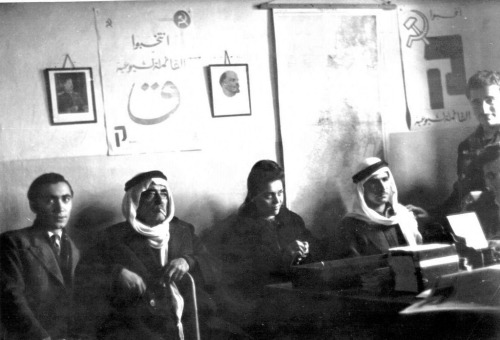 |
| Arab members of Maki, the “Israeli” Communist Party (a descendant of the Palestine Communist Party) in 1949. In 1965 the party split into two factions, one Zionist and the other anti-Zionist. The Zionist faction retained the name Maki, while the anti-Zionist faction named itself Rakah. The Soviet Union recognized Rakah as the official communist party in Palestine quickly after its formation. Rakah still exists today, and ironically, it has renamed itself Maki, while the original (Zionist) Maki has been disbanded. |
The Israeli Communist Party, Maki, which is
represented by Hadash in the Arab-Jewish Joint List in the Knesset and which
has 5 out of the 13 seats that the Joint List holds, has had a chequered
history. Its leader in 1948 Meir Vilner signed the Israeli Declaration of
Independence and it followed Stalin in Moscow in recognising the Zionist
state. In 1965 Maki split and the Jewish
section led by Moshe Sneh moved off in a Zionist direction. The largely Arab part went on to form Rakah which became with the alliance with other small
groups like the Black Panthers, Hadash.
Tikva Honig-Parnass was raised in the
Jewish community of pre-state Palestine, fought in the 1948 war and served as
the secretary of the then Radical Left Zionist Party of Mapam (The Unified
Workers Party) in the Knesset ( 1951-1954). In ’60 she definitively broke with
Zionism and joined the ranks of the Israeli Socialist Organization, known as
“Matzpen”. Since then she has played an active role in the movement
against the ’67 occupation as well as in the struggle for the Palestinian
national rights. She co-edited
Between the Lines with Toufic Haddad
Jewish community of pre-state Palestine, fought in the 1948 war and served as
the secretary of the then Radical Left Zionist Party of Mapam (The Unified
Workers Party) in the Knesset ( 1951-1954). In ’60 she definitively broke with
Zionism and joined the ranks of the Israeli Socialist Organization, known as
“Matzpen”. Since then she has played an active role in the movement
against the ’67 occupation as well as in the struggle for the Palestinian
national rights. She co-edited
Between the Lines with Toufic Haddad
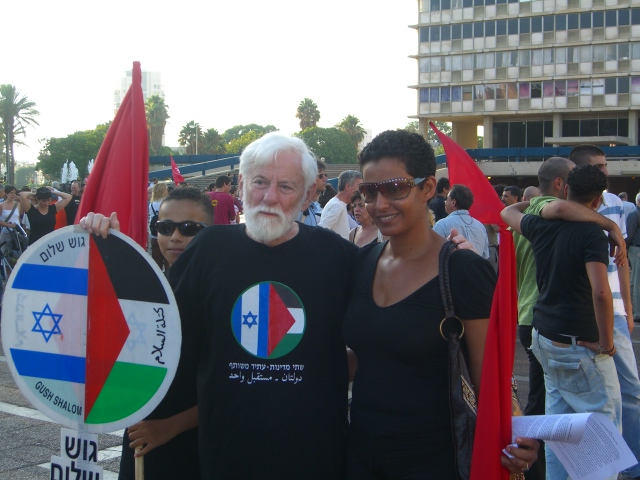 |
| Uri Avneri at Hadash Demonstration Against the Lebanon War 1982 |
At the Marx Conference which took place on
November 27, MK Dov Khenin, a leader of the Israeli Communist Party(Maki) gave
a lecture named :”But the point is to change it” (Published in Hagada
Hasmalit , November 28, where the entire sentence from the Theses on Feuerbach
was posted: “The philosophers have only interpreted the world, in various
ways; the point is to change it“) The struggle against Zionism and its
embodiment in the settler colonial state of Israel is fundamental to any
strategy aiming at a thorough change of Israel and the entire region.
November 27, MK Dov Khenin, a leader of the Israeli Communist Party(Maki) gave
a lecture named :”But the point is to change it” (Published in Hagada
Hasmalit , November 28, where the entire sentence from the Theses on Feuerbach
was posted: “The philosophers have only interpreted the world, in various
ways; the point is to change it“) The struggle against Zionism and its
embodiment in the settler colonial state of Israel is fundamental to any
strategy aiming at a thorough change of Israel and the entire region.
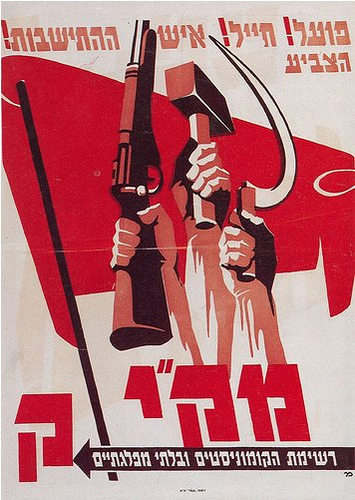
However, Dov Khenin presents his suggested
road to change without uttering the word Zionism nor relating to the need to
dismantle the Zionist colonial state as a necessary condition to his strategy
for change.
road to change without uttering the word Zionism nor relating to the need to
dismantle the Zionist colonial state as a necessary condition to his strategy
for change.
Some would argue against my going back to
the “original sin” of the old Stalinist Maki of 1948* for tracing
today’s Khenin and his Party’s political positions. I refer to the old Maki (
The Israeli Communist Party) which was a signatory (through its leader Meir
Vilner) of the infamous “Declaration of Independence”. It took place
on May 14 ,1948 when occupations of Palestinian towns and villages and the and
brutal expulsions of their residents were already in full volume. Maki trailed
the Soviet Union support for the 1947 UN Partition Plan which recognized a
Jewish state and confirmed the Zionist claim for historic rights in Palestine,
as emphasized in the Declaration.
the “original sin” of the old Stalinist Maki of 1948* for tracing
today’s Khenin and his Party’s political positions. I refer to the old Maki (
The Israeli Communist Party) which was a signatory (through its leader Meir
Vilner) of the infamous “Declaration of Independence”. It took place
on May 14 ,1948 when occupations of Palestinian towns and villages and the and
brutal expulsions of their residents were already in full volume. Maki trailed
the Soviet Union support for the 1947 UN Partition Plan which recognized a
Jewish state and confirmed the Zionist claim for historic rights in Palestine,
as emphasized in the Declaration.
 |
| Judaism & Communism |
Indeed the Israeli Communist Party of
(Maki) of today is not the same as the 1948 Maki from which it split during the
’60 and later assumed its name. The present Maki heads the political alliance
known as Hadash- actually, the heiress of Rakah- formed after split between a
largely Jewish faction led by Moshe Sneh. Still, I mention the 1948 signature
because the Israeli Communist Party , until this day has not made a true
criticism of its conduct during all the years of Soviet rule nor has it
examined its traditional position on the partition plan or its present form of
2 states solution .The different suggested border does not change the essence
of this solution which in the long run does recognize a Bantustan state
alongside a Jewish state.
(Maki) of today is not the same as the 1948 Maki from which it split during the
’60 and later assumed its name. The present Maki heads the political alliance
known as Hadash- actually, the heiress of Rakah- formed after split between a
largely Jewish faction led by Moshe Sneh. Still, I mention the 1948 signature
because the Israeli Communist Party , until this day has not made a true
criticism of its conduct during all the years of Soviet rule nor has it
examined its traditional position on the partition plan or its present form of
2 states solution .The different suggested border does not change the essence
of this solution which in the long run does recognize a Bantustan state
alongside a Jewish state.
** Thus, even if the present positions of Maki don’t
derive directly from the 48′ Stalinist pro-Zionist stance, the latter still
echoes in Maki’s lack of explicit self criticism and its self definition as
“non Zionist “.
derive directly from the 48′ Stalinist pro-Zionist stance, the latter still
echoes in Maki’s lack of explicit self criticism and its self definition as
“non Zionist “.
Maki’s continued support for it’s main
faults of the past, is reflected in Dov Khenin’s article: He Ignores the
colonialist nature of Israel as a central characteristic that should be the
starting point and base of any analysis of Israel’s political regime and its
class struggle. Hence, Maki’s claim of adhering to Marxism-Leninism for
designing its “strategy for change”, appears to be but somewhat empty
words as long as its political positions are not placed within the framework of
Israel as a settler colonial state.
faults of the past, is reflected in Dov Khenin’s article: He Ignores the
colonialist nature of Israel as a central characteristic that should be the
starting point and base of any analysis of Israel’s political regime and its
class struggle. Hence, Maki’s claim of adhering to Marxism-Leninism for
designing its “strategy for change”, appears to be but somewhat empty
words as long as its political positions are not placed within the framework of
Israel as a settler colonial state.
Dov Khanin presents the fronts and blocks
which workers’ parties created in the October and Chinese Revolutions ( as well
as Gramsci’s writings) as models on which “the class project should be
based” :”The common denominator of these examples” he says,
“is that revolutionaries’ seek to see in their societies the ” actual
lines of collisions and thus create a power that can advance the revolutionary
change.”
which workers’ parties created in the October and Chinese Revolutions ( as well
as Gramsci’s writings) as models on which “the class project should be
based” :”The common denominator of these examples” he says,
“is that revolutionaries’ seek to see in their societies the ” actual
lines of collisions and thus create a power that can advance the revolutionary
change.”
This is how Khenin applies these examples to
in his analysis of Israeli society today and the strategy for its change: Israel is prey to one of Late Capitalism
characteristics, namely the way in which it “dismantles social structures
with the aid of Globalization and its economic and ideological hegemony.”
Hence, “We should do today what Marx[ists?] did then- to trace the
subjects for change in our society. Of course the working class is such a
subject. But the Israeli working class is complex and weak. It is very large
but fragmented.[..]
in his analysis of Israeli society today and the strategy for its change: Israel is prey to one of Late Capitalism
characteristics, namely the way in which it “dismantles social structures
with the aid of Globalization and its economic and ideological hegemony.”
Hence, “We should do today what Marx[ists?] did then- to trace the
subjects for change in our society. Of course the working class is such a
subject. But the Israeli working class is complex and weak. It is very large
but fragmented.[..]
The challenge is to crystallize a new
historic block in which “the working class is significant but not
exclusive.” This Block should include all the oppressed groups in Israeli
society which ” more than any other society in the world suffers from a
lot of deep and true wounds beyond the class dimension.”
historic block in which “the working class is significant but not
exclusive.” This Block should include all the oppressed groups in Israeli
society which ” more than any other society in the world suffers from a
lot of deep and true wounds beyond the class dimension.”
These wounds include : “THE NATIONAL
wound of the Palestinians, and also of the Jews, the ETHNIC [MIZRAHI] wound
which stems from the melting pot[The false declared policy aimed at creating
one homogeneous people out of the variety of immigrant Jews) that erased
traditions and cultures, GENDER wounds which stems from a patriarchal society,
etc.”
wound of the Palestinians, and also of the Jews, the ETHNIC [MIZRAHI] wound
which stems from the melting pot[The false declared policy aimed at creating
one homogeneous people out of the variety of immigrant Jews) that erased
traditions and cultures, GENDER wounds which stems from a patriarchal society,
etc.”
The Task of Maki is to understand the
concrete political role of these wounds which are exploited as a mechanisms for
preserving the system”. Khenin presents the “Mizrahi wound” as
an example: “[It} has been formed against the establishment elites of the
labor movement’ and thus became “the base for the historic block which
keeps the rule of the Right.”
concrete political role of these wounds which are exploited as a mechanisms for
preserving the system”. Khenin presents the “Mizrahi wound” as
an example: “[It} has been formed against the establishment elites of the
labor movement’ and thus became “the base for the historic block which
keeps the rule of the Right.”
According to Khenin another essential
problem of “this land” [in addition to its “wounds “] is
the weakness of the class struggle. The labor movement (Mapai and Labor) is
historically responsible for it, since “Like any other Social Democracy it
evaporated the idea of class struggle.”
problem of “this land” [in addition to its “wounds “] is
the weakness of the class struggle. The labor movement (Mapai and Labor) is
historically responsible for it, since “Like any other Social Democracy it
evaporated the idea of class struggle.”
The use of the term the
“national” wound which Khenin uses for “Palestinians and also
Israelis”, echoes the Zionist left conception of a “national
conflict” between two peoples who have right one land, rather than seeing
the conflict as that between colonizers and colonized. Hence, Khenin is carefyl
not to point to the source from which the “national wound” stems as
he does for the other two- the Mizrahi and gender wounds. Further, The national
issue is reduced to just one of the many “identity wounds” which
characterize Israel as if it is just another Nation-state which the examples of
the October or China revolutions rather than the anti colonial liberation
movements apply to it.
“national” wound which Khenin uses for “Palestinians and also
Israelis”, echoes the Zionist left conception of a “national
conflict” between two peoples who have right one land, rather than seeing
the conflict as that between colonizers and colonized. Hence, Khenin is carefyl
not to point to the source from which the “national wound” stems as
he does for the other two- the Mizrahi and gender wounds. Further, The national
issue is reduced to just one of the many “identity wounds” which
characterize Israel as if it is just another Nation-state which the examples of
the October or China revolutions rather than the anti colonial liberation
movements apply to it.
Elaborating on the “national
wound” would have required Khenin to explicitly express his position
towards Zionism and Israel as a settlers colonial state and society which
dictates the nature of its class struggle and the real strategy for its
revolutionary change – dismantling the Zionist apartheid state.
wound” would have required Khenin to explicitly express his position
towards Zionism and Israel as a settlers colonial state and society which
dictates the nature of its class struggle and the real strategy for its
revolutionary change – dismantling the Zionist apartheid state.
Furthermore, in accord with Maki’s
traditional support of 2 states solution Khenin ignores the fact that Israel
already rules the entire historic Palestine and would continue ruling it for
many years to come. No doubt this is an additional factor which necessitates a
re-thinking of the nature of the class struggle out side the box of pre ’67
Israel to which Khenin limits his analysis. To be on the safe side he does not
mention even the ’67 occupation and focuses his proposal for political strategy
on ‘Israel proper’ alone.***
traditional support of 2 states solution Khenin ignores the fact that Israel
already rules the entire historic Palestine and would continue ruling it for
many years to come. No doubt this is an additional factor which necessitates a
re-thinking of the nature of the class struggle out side the box of pre ’67
Israel to which Khenin limits his analysis. To be on the safe side he does not
mention even the ’67 occupation and focuses his proposal for political strategy
on ‘Israel proper’ alone.***
All in all the communist Party in Israel
has not passed through a significant radical change towards an anti Zionist
stance which derives from a solid Marxist, anti Imperialist and class
perspective. The need of such a revolutionary party is at present acute more
than ever.
has not passed through a significant radical change towards an anti Zionist
stance which derives from a solid Marxist, anti Imperialist and class
perspective. The need of such a revolutionary party is at present acute more
than ever.
* Maki was a descendant of the Palestinian
Communist Party (PCP), which changed its name to MAKEI (the Communist Party of
Eretz Yisrael) after endorsing partition in 1947, and then to Maki. Members of
the National Liberation League, an Arab party that had split off from the PCP
in 1944, rejoined Maki in October 1948, giving the party both Jewish and
Israeli Arab members
Communist Party (PCP), which changed its name to MAKEI (the Communist Party of
Eretz Yisrael) after endorsing partition in 1947, and then to Maki. Members of
the National Liberation League, an Arab party that had split off from the PCP
in 1944, rejoined Maki in October 1948, giving the party both Jewish and
Israeli Arab members
** Israel Poterman: The Soviet Union
Support for the Partition Plan- vision and Reality, Hagada Hasmalit January 31
2004).
Support for the Partition Plan- vision and Reality, Hagada Hasmalit January 31
2004).
*** Ill spare the reader from a detailed
report on Khenin’s pathetic self appraisal experience in creating the right
block in “A Town For Us” – a list which ran in the elections to Tel
Aviv municipality in 2008 and 2013.( It yielded 5 and 3 out of 31 members in
the Tel-Aviv Municipality Council, respectively.)
report on Khenin’s pathetic self appraisal experience in creating the right
block in “A Town For Us” – a list which ran in the elections to Tel
Aviv municipality in 2008 and 2013.( It yielded 5 and 3 out of 31 members in
the Tel-Aviv Municipality Council, respectively.)
Posted in Blog
