Saudi Financed Israeli Settlements
 |
| Netanyahu and Saudi friends |
Once upon
a time, the Arab regimes made a pretence of opposing Israel and Zionism. Today they don’t even do that. Not only do Israel and Saudi Arabia have a de facto military and political alliance,
the article below shows that Saudi Arabia has actually been funding Israel to
the tune of £16 billion.
a time, the Arab regimes made a pretence of opposing Israel and Zionism. Today they don’t even do that. Not only do Israel and Saudi Arabia have a de facto military and political alliance,
the article below shows that Saudi Arabia has actually been funding Israel to
the tune of £16 billion.
One
reason for this strategic alliance is that Iran is their common enemy. Saudi Arabia has been financing Al Qaeda and
ISIS and Israel has made it clear that it considers the war against ISIS to be the
wrong war.
reason for this strategic alliance is that Iran is their common enemy. Saudi Arabia has been financing Al Qaeda and
ISIS and Israel has made it clear that it considers the war against ISIS to be the
wrong war.
Tony Greenstein

 |
| A new flag? |
Did Money Seal Israeli-Saudi Alliance?
April 15, 2015
Special Report: The
odd-couple relationship between Saudi Arabia and Israel may have been sealed
with more than a mutual desire to kiss-off Iran. According to an intelligence
source, there was a dowry involved, too, with the Saudis reportedly giving
Israel some $16 billion, writes Robert Parry.
odd-couple relationship between Saudi Arabia and Israel may have been sealed
with more than a mutual desire to kiss-off Iran. According to an intelligence
source, there was a dowry involved, too, with the Saudis reportedly giving
Israel some $16 billion, writes Robert Parry.

For more than half a century, Saudi Arabia has tried to
use its vast oil wealth to build a lobby in the United States that could rival
the imposing Israel Lobby. At top dollar, the Saudis hired law firms and PR
specialists – and exploited personal connections to powerful families like the
Bushes – but the Saudis never could build the kind of grassroots political
organization that has given Israel and its American backers such extraordinary
clout.
use its vast oil wealth to build a lobby in the United States that could rival
the imposing Israel Lobby. At top dollar, the Saudis hired law firms and PR
specialists – and exploited personal connections to powerful families like the
Bushes – but the Saudis never could build the kind of grassroots political
organization that has given Israel and its American backers such extraordinary
clout.
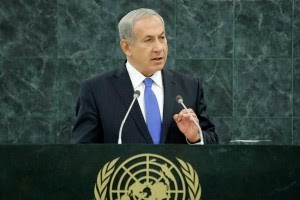 |
| Netanyahu speaking at UN on behalf of Israel and Saudi Arabia |
Indeed, Americans who did take Saudi money – including
academic institutions and non-governmental organizations – were often pilloried
as tools of the Arabs, with the Israel Lobby and its propagandists raising the
political cost of accepting Saudi largesse so high that many people and
institutions shied away.
academic institutions and non-governmental organizations – were often pilloried
as tools of the Arabs, with the Israel Lobby and its propagandists raising the
political cost of accepting Saudi largesse so high that many people and
institutions shied away.
 |
| The racist face of Zionism |
President Obama and King Salman Arabia stand at
attention during the U.S. national anthem as the First Lady stands in the
background with other officials. (Official White House Photo by Pete Souza)
attention during the U.S. national anthem as the First Lady stands in the
background with other officials. (Official White House Photo by Pete Souza)
But Saudi Arabia may have found another way to buy
influence inside the United States – by giving money to Israel and
currying favor with Israeli Prime Minister Benjamin Netanyahu. Over the past
several years, as both Saudi Arabia and Israel have identified Iran and the so-called
“Shiite crescent” as their principal enemies, this once-unthinkable
alliance has become possible – and the Saudis, as they are wont to do, may
have thrown lots of money into the deal.
influence inside the United States – by giving money to Israel and
currying favor with Israeli Prime Minister Benjamin Netanyahu. Over the past
several years, as both Saudi Arabia and Israel have identified Iran and the so-called
“Shiite crescent” as their principal enemies, this once-unthinkable
alliance has become possible – and the Saudis, as they are wont to do, may
have thrown lots of money into the deal.
 |
| Obama and paymaster |
According to a source briefed by U.S. intelligence
analysts, the Saudis have given Israel at least $16 billion over the past 2 ½
years, funneling the money through a third-country Arab state and into an
Israeli “development” account in Europe to help finance infrastructure inside
Israel. The source first called the account “a Netanyahu slush fund,” but later
refined that characterization, saying the money was used for public projects
such as building settlements in the West Bank.
analysts, the Saudis have given Israel at least $16 billion over the past 2 ½
years, funneling the money through a third-country Arab state and into an
Israeli “development” account in Europe to help finance infrastructure inside
Israel. The source first called the account “a Netanyahu slush fund,” but later
refined that characterization, saying the money was used for public projects
such as building settlements in the West Bank.
 |
| Former Saudi ambassador Prince Turki bin Faisal and Israeli strategic affairs analyst Yossi Alpher/Photo: PressTV |
In other words, according to this information, the
Saudis concluded that if you can’t beat the Israel Lobby, try buying it. And,
if that is the case, the Saudis have found their
behind-the-scenes collaboration with Israel extremely valuable. Netanyahu
has played a key role in lining up the U.S. Congress to fight an international
agreement to resolve a long-running dispute over Iran’s nuclear program.
Saudis concluded that if you can’t beat the Israel Lobby, try buying it. And,
if that is the case, the Saudis have found their
behind-the-scenes collaboration with Israel extremely valuable. Netanyahu
has played a key role in lining up the U.S. Congress to fight an international
agreement to resolve a long-running dispute over Iran’s nuclear program.
Urged on by Netanyahu, the Republican majority and many
Democrats have committed themselves to destroying the framework agreement
hammered out on April 2 by Iran and six world powers, including the United States.
The deal would impose strict inspections and other limits to guarantee that
Iran’s nuclear program remains peaceful.
Democrats have committed themselves to destroying the framework agreement
hammered out on April 2 by Iran and six world powers, including the United States.
The deal would impose strict inspections and other limits to guarantee that
Iran’s nuclear program remains peaceful.
By crashing the deal, Israel and Saudi Arabia would open
the door to more punitive sanctions on Iran and possibly clear the way for
Israeli airstrikes, with Saudi Arabia granting over-flight permission to Israeli warplanes. The Saudi-Israeli tandem also
might hope to pull in the U.S. military to inflict even more devastation on
Iranian targets.
the door to more punitive sanctions on Iran and possibly clear the way for
Israeli airstrikes, with Saudi Arabia granting over-flight permission to Israeli warplanes. The Saudi-Israeli tandem also
might hope to pull in the U.S. military to inflict even more devastation on
Iranian targets.
Neither the Israeli nor Saudi governments responded to
requests for comment on Saudi payments into an Israeli account.
requests for comment on Saudi payments into an Israeli account.
Congressional Acclaim
The reported Saudi-to-Israel money transfers put
Netanyahu’s March 3 speech to a cheering joint session of the U.S. Congress in
a different light, too. The Prime Minister’s bitter denunciations of Iran
before hundreds of transfixed American lawmakers could be viewed as him
demonstrating his value to the Saudi royals who could never dream of getting
that kind of reaction themselves.
Netanyahu’s March 3 speech to a cheering joint session of the U.S. Congress in
a different light, too. The Prime Minister’s bitter denunciations of Iran
before hundreds of transfixed American lawmakers could be viewed as him
demonstrating his value to the Saudi royals who could never dream of getting
that kind of reaction themselves.
Indeed, as Congress now moves to sabotage the Iranian
nuclear agreement, the Saudis could be finding that whatever money they
invested in Israel is money well spent. The Saudis seem especially alarmed that
the nuclear agreement would prompt the world community to lift sanctions on
Iran, thus allowing its economy – and its influence – to grow.
nuclear agreement, the Saudis could be finding that whatever money they
invested in Israel is money well spent. The Saudis seem especially alarmed that
the nuclear agreement would prompt the world community to lift sanctions on
Iran, thus allowing its economy – and its influence – to grow.
To prevent that, the Saudis desperately want to draw the
United States in on the Sunni side of the historic Sunni-Shiite conflict, with
Netanyahu serving as a crucial middleman by defying President Barack Obama on
the Iran deal and bringing the full force of the Israel Lobby to bear on
Congress and on the opinion circles of Official Washington.
United States in on the Sunni side of the historic Sunni-Shiite conflict, with
Netanyahu serving as a crucial middleman by defying President Barack Obama on
the Iran deal and bringing the full force of the Israel Lobby to bear on
Congress and on the opinion circles of Official Washington.
If Netanyahu and the Saudis succeed in collapsing the
Iran nuclear framework agreement, they will have made great strides toward
enlisting the United States as the primary military force on the Sunni
side of the Sunni-Shiite sectarian divide, a dispute that dates back to the
succession struggle after Prophet Muhammad’s death in 632.
Iran nuclear framework agreement, they will have made great strides toward
enlisting the United States as the primary military force on the Sunni
side of the Sunni-Shiite sectarian divide, a dispute that dates back to the
succession struggle after Prophet Muhammad’s death in 632.
This ancient feud has become a Saudi obsession over the
past several decades, at least since Iran’s Shiite revolution overthrew the
Shah of Iran in 1979 and brought to power the Islamic government of Ayatollah
Ruhollah Khomeini.
past several decades, at least since Iran’s Shiite revolution overthrew the
Shah of Iran in 1979 and brought to power the Islamic government of Ayatollah
Ruhollah Khomeini.
Upset with the ouster of a fellow monarch, the Shah, and
fearing the spread of Khomeini’s ascetic form of Shiite Islamic governance, the
Saudi royals summoned Iraqi dictator Saddam Hussein, a fellow Sunni, to Riyadh
on Aug. 5, 1980, to encourage him to invade Iran.
fearing the spread of Khomeini’s ascetic form of Shiite Islamic governance, the
Saudi royals summoned Iraqi dictator Saddam Hussein, a fellow Sunni, to Riyadh
on Aug. 5, 1980, to encourage him to invade Iran.
According to top secret “Talking Points” that
Secretary of State Alexander Haig prepared for a briefing of President Ronald
Reagan after Haig’s April 1981 trip to the Middle East, Haig wrote that Saudi
Prince Fahd said he told the Iraqis that an invasion of Iran would have U.S.
support.
Secretary of State Alexander Haig prepared for a briefing of President Ronald
Reagan after Haig’s April 1981 trip to the Middle East, Haig wrote that Saudi
Prince Fahd said he told the Iraqis that an invasion of Iran would have U.S.
support.
“It was … interesting to confirm that President [Jimmy]
Carter gave the Iraqis a green light to launch the war against Iran through
Fahd,” Haig wrote, in the document that I discovered in U.S. congressional
files in 1994. Though Carter has denied encouraging the Iraqi invasion, which
came as Iran was holding 52 U.S. diplomats hostage, Haig’s “Talking Points”
suggest that the Saudis at least led Hussein to believe that the war had U.S.
blessings.
Carter gave the Iraqis a green light to launch the war against Iran through
Fahd,” Haig wrote, in the document that I discovered in U.S. congressional
files in 1994. Though Carter has denied encouraging the Iraqi invasion, which
came as Iran was holding 52 U.S. diplomats hostage, Haig’s “Talking Points”
suggest that the Saudis at least led Hussein to believe that the war had U.S.
blessings.
Haig also noted that even after the overthrow of the
Shah and the establishment of the Islamic state under Khomeini, Israel sought
to maintain its clandestine relations with Iran by serving as an arms
supplier. Haig reported that “Both [Egypt’s Anwar] Sadat and [Saudi Prince]
Fahd [explained that] Iran is receiving military spares for U.S. equipment from
Israel.”
Shah and the establishment of the Islamic state under Khomeini, Israel sought
to maintain its clandestine relations with Iran by serving as an arms
supplier. Haig reported that “Both [Egypt’s Anwar] Sadat and [Saudi Prince]
Fahd [explained that] Iran is receiving military spares for U.S. equipment from
Israel.”
Those Israeli weapons sales continued through the eight
bloody years of the Iran-Iraq War with some estimates of the value reaching
into the scores of billions of dollar. The Israelis even helped bring the
Reagan administration into the deals in the mid-1980s with the so-called
Iran-Contra arms shipments that involved secret off-the-books bank accounts in
Europe and led to the worst scandal of Reagan’s presidency.
bloody years of the Iran-Iraq War with some estimates of the value reaching
into the scores of billions of dollar. The Israelis even helped bring the
Reagan administration into the deals in the mid-1980s with the so-called
Iran-Contra arms shipments that involved secret off-the-books bank accounts in
Europe and led to the worst scandal of Reagan’s presidency.
Rise of the Neocons
In the 1990s – with the Iran-Iraq war over and Iran’s
treasury depleted – Israeli attitudes cooled toward its erstwhile trading
partner. Meanwhile, American neocons – juiced by the demonstration of U.S.
military supremacy against Iraq during the Persian Gulf War in 1991 and the
collapse of the Soviet Union leaving the U.S. as “the sole superpower” – began
advising Netanyahu on employing “regime change” to alter the Mideast dynamic.
treasury depleted – Israeli attitudes cooled toward its erstwhile trading
partner. Meanwhile, American neocons – juiced by the demonstration of U.S.
military supremacy against Iraq during the Persian Gulf War in 1991 and the
collapse of the Soviet Union leaving the U.S. as “the sole superpower” – began
advising Netanyahu on employing “regime change” to alter the Mideast dynamic.
During Netanyahu’s 1996 campaign, prominent neocons
including Richard Perle and Douglas Feith outlined the plan in a policy paper
entitled “A Clean Break: A New Strategy for Securing the Realm.” The document
argued that “Israel can shape its strategic environment … by weakening,
containing, and even rolling back Syria. This effort can focus on removing
Saddam Hussein from power in Iraq – an important Israeli strategic objective in
its own right — as a means of foiling Syria’s regional ambitions.” [See
Consortiumnews.com’s “The Mysterious Why of the Iraq War.”]
including Richard Perle and Douglas Feith outlined the plan in a policy paper
entitled “A Clean Break: A New Strategy for Securing the Realm.” The document
argued that “Israel can shape its strategic environment … by weakening,
containing, and even rolling back Syria. This effort can focus on removing
Saddam Hussein from power in Iraq – an important Israeli strategic objective in
its own right — as a means of foiling Syria’s regional ambitions.” [See
Consortiumnews.com’s “The Mysterious Why of the Iraq War.”]
The overriding point of this neocon strategy was that by
imposing “regime change” in Muslim nations that were deemed hostile to Israel,
new friendly governments could be put in place, thus leaving Israel’s close-in
enemies – Hamas in Palestine and Hezbollah in Lebanon – without outside
sponsors. Starved of money, these troublesome enemies would be forced to accept
Israel’s terms. “The Realm” would be secured.
imposing “regime change” in Muslim nations that were deemed hostile to Israel,
new friendly governments could be put in place, thus leaving Israel’s close-in
enemies – Hamas in Palestine and Hezbollah in Lebanon – without outside
sponsors. Starved of money, these troublesome enemies would be forced to accept
Israel’s terms. “The Realm” would be secured.
The neocons first target was Sunni-ruled Iraq, as their
Project for the New American Century made clear in 1998, but Syria and Iran
were next on the hit list. Syria is governed by the Assads who are Alawites, an
offshoot of Shiite Islam, and Iran is governed by Shiites. The neocon plan was
to use U.S. military force or other means of subversion to take out all three
regimes.
Project for the New American Century made clear in 1998, but Syria and Iran
were next on the hit list. Syria is governed by the Assads who are Alawites, an
offshoot of Shiite Islam, and Iran is governed by Shiites. The neocon plan was
to use U.S. military force or other means of subversion to take out all three
regimes.
However, when the neocons got their chance to invade
Iraq in 2003, they inadvertently tipped the Mideast balance in favor of the
Shiites, since Iraq’s Shiite majority gained control under the U.S. military
occupation. Plus, the disastrous U.S. war precluded the neocons from completing
their agenda of enforced “regime change” in Syria and Iran.
Iraq in 2003, they inadvertently tipped the Mideast balance in favor of the
Shiites, since Iraq’s Shiite majority gained control under the U.S. military
occupation. Plus, the disastrous U.S. war precluded the neocons from completing
their agenda of enforced “regime change” in Syria and Iran.
With the new Iraqi government suddenly friendly with
Iran’s Shiite leaders, Saudi Arabia became increasingly alarmed. Israel was
also coming to view the so-called “Shiite crescent” from Tehran through Baghdad
and Damascus to Beirut as a strategic threat.
Iran’s Shiite leaders, Saudi Arabia became increasingly alarmed. Israel was
also coming to view the so-called “Shiite crescent” from Tehran through Baghdad
and Damascus to Beirut as a strategic threat.
Saudi Arabia, working with Turkey, took aim at the
center of that crescent in 2011 by supporting a Sunni-led opposition to the
government of Syrian President Bashar al-Assad, a set of protests that quickly
spiraled into bloody terrorist attacks and harsh military repression.
center of that crescent in 2011 by supporting a Sunni-led opposition to the
government of Syrian President Bashar al-Assad, a set of protests that quickly
spiraled into bloody terrorist attacks and harsh military repression.
By 2013, it was clear that the principal fighters
against Assad’s government were not the fictional “moderates” touted by the
U.S. mainstream media but Al-Qaeda’s Nusra Front and a hyper-brutal Al-Qaeda
spinoff that arose in resistance to the U.S. occupation of Iraq and evolved
into the “Islamic State of Iraq and Syria” or simply the “Islamic State.”
against Assad’s government were not the fictional “moderates” touted by the
U.S. mainstream media but Al-Qaeda’s Nusra Front and a hyper-brutal Al-Qaeda
spinoff that arose in resistance to the U.S. occupation of Iraq and evolved
into the “Islamic State of Iraq and Syria” or simply the “Islamic State.”
Israeli Preference
To the surprise of some observers, Israel began voicing
a preference for Al-Qaeda’s militants over the relatively secular Assad
government, which was viewed as the protectors of Alawites, Shiites, Christians
and other Syrian minorities terrified of the Saudi-backed Sunni extremists.
a preference for Al-Qaeda’s militants over the relatively secular Assad
government, which was viewed as the protectors of Alawites, Shiites, Christians
and other Syrian minorities terrified of the Saudi-backed Sunni extremists.
In September 2013, in one of the most explicit
expressions of Israel’s views, Israeli Ambassador to the United States Michael
Oren, then a close adviser to Netanyahu, told the Jerusalem Post that Israel
favored the Sunni extremists over Assad.
expressions of Israel’s views, Israeli Ambassador to the United States Michael
Oren, then a close adviser to Netanyahu, told the Jerusalem Post that Israel
favored the Sunni extremists over Assad.
“The greatest danger to Israel is by the strategic arc
that extends from Tehran, to Damascus to Beirut. And we saw the Assad regime as
the keystone in that arc,” Oren told the Jerusalem Post in an interview. “We always
wanted Bashar Assad to go, we always preferred the bad guys who weren’t backed
by Iran to the bad guys who were backed by Iran.” He said this was the
case even if the “bad guys” were affiliated with Al-Qaeda.
that extends from Tehran, to Damascus to Beirut. And we saw the Assad regime as
the keystone in that arc,” Oren told the Jerusalem Post in an interview. “We always
wanted Bashar Assad to go, we always preferred the bad guys who weren’t backed
by Iran to the bad guys who were backed by Iran.” He said this was the
case even if the “bad guys” were affiliated with Al-Qaeda.
Oren expanded on his position in June 2014 at an Aspen
Institute conference. Then, speaking as a former ambassador, Oren said Israel would even prefer a victory by the Islamic
State, which was massacring captured Iraqi soldiers and beheading Westerners,
than the continuation of the Iranian-backed Assad in Syria.
Institute conference. Then, speaking as a former ambassador, Oren said Israel would even prefer a victory by the Islamic
State, which was massacring captured Iraqi soldiers and beheading Westerners,
than the continuation of the Iranian-backed Assad in Syria.
“From Israel’s perspective, if there’s got to be an evil
that’s got to prevail, let the Sunni evil prevail,” Oren said.
that’s got to prevail, let the Sunni evil prevail,” Oren said.
Israeli Prime Minister Benjamin Netanyahu speaking to
the United Nations General Assembly on Oct. 1, 2013. (UN Photo by Evan
Schneider)
the United Nations General Assembly on Oct. 1, 2013. (UN Photo by Evan
Schneider)
On Oct. 1, 2013, Israeli Prime Minister Netanyahu hinted
at the new Israeli-Saudi relationship in his United Nations General Assembly
speech, which was largely devoted to excoriating Iran over its nuclear program
and threatening a unilateral Israeli military strike.
at the new Israeli-Saudi relationship in his United Nations General Assembly
speech, which was largely devoted to excoriating Iran over its nuclear program
and threatening a unilateral Israeli military strike.
Amid the bellicosity, Netanyahu dropped in a largely
missed clue about the evolving power relationships in the Middle East, saying:
“The dangers of a nuclear-armed Iran and the emergence of other threats in our
region have led many of our Arab neighbors to recognize, finally recognize,
that Israel is not their enemy. And this affords us the opportunity to overcome
the historic animosities and build new relationships, new friendships, new
hopes.”
missed clue about the evolving power relationships in the Middle East, saying:
“The dangers of a nuclear-armed Iran and the emergence of other threats in our
region have led many of our Arab neighbors to recognize, finally recognize,
that Israel is not their enemy. And this affords us the opportunity to overcome
the historic animosities and build new relationships, new friendships, new
hopes.”
The next day, Israel’s Channel 2 TV news reported that senior
Israeli security officials had met with a high-level Gulf state counterpart in
Jerusalem, believed to be Prince Bandar bin Sultan, the former Saudi ambassador
to the United States who was then head of Saudi intelligence.
Israeli security officials had met with a high-level Gulf state counterpart in
Jerusalem, believed to be Prince Bandar bin Sultan, the former Saudi ambassador
to the United States who was then head of Saudi intelligence.
The reality of this unlikely alliance has even reached
the mainstream U.S. media. For instance, Time magazine correspondent Joe Klein described the new coziness in an article in the Jan. 19, 2015
issue: “On May 26, 2014, an unprecedented public conversation took place in
Brussels. Two former high-ranking spymasters of Israel and Saudi Arabia – Amos
Yadlin and Prince Turki al-Faisal – sat together for more than an hour, talking
regional politics in a conversation moderated by the Washington Post’s David
Ignatius.
the mainstream U.S. media. For instance, Time magazine correspondent Joe Klein described the new coziness in an article in the Jan. 19, 2015
issue: “On May 26, 2014, an unprecedented public conversation took place in
Brussels. Two former high-ranking spymasters of Israel and Saudi Arabia – Amos
Yadlin and Prince Turki al-Faisal – sat together for more than an hour, talking
regional politics in a conversation moderated by the Washington Post’s David
Ignatius.
“They disagreed on some things, like the exact nature of
an Israel-Palestine peace settlement, and agreed on others: the severity of the
Iranian nuclear threat, the need to support the new military government in
Egypt, the demand for concerted international action in Syria. The most
striking statement came from Prince Turki. He said the Arabs had ‘crossed the
Rubicon’ and ‘don’t want to fight Israel anymore.’”
an Israel-Palestine peace settlement, and agreed on others: the severity of the
Iranian nuclear threat, the need to support the new military government in
Egypt, the demand for concerted international action in Syria. The most
striking statement came from Prince Turki. He said the Arabs had ‘crossed the
Rubicon’ and ‘don’t want to fight Israel anymore.’”
While the Saudis may still pay lip service to the plight
of the Palestinians, that issue is no longer much of a priority. Indeed, the
Saudi royals may view the Palestinians, many of whom are secular having seen
first-hand the evils of Islamic extremism, as something of a regional threat to
the Saudi monarchical governance which is based on an ultra-fundamentalist
form of Islam known as Wahhabism. That some of the reported $16 billion Saudi
payment to Israel was going to finance Israeli settlements on the Palestinian
West Bank would further reflect this Saudi indifference.
of the Palestinians, that issue is no longer much of a priority. Indeed, the
Saudi royals may view the Palestinians, many of whom are secular having seen
first-hand the evils of Islamic extremism, as something of a regional threat to
the Saudi monarchical governance which is based on an ultra-fundamentalist
form of Islam known as Wahhabism. That some of the reported $16 billion Saudi
payment to Israel was going to finance Israeli settlements on the Palestinian
West Bank would further reflect this Saudi indifference.
In 2013, again collaborating with Israel, Saudi Arabia
helped deal a devastating blow to the 1.8 million Palestinians locked in the
Gaza Strip. They had received some relief when Egypt
elected the Muslim Brotherhood government of President Mohamed Morsi,
who relaxed the embargo on passage between Egyptian territory and Gaza.
helped deal a devastating blow to the 1.8 million Palestinians locked in the
Gaza Strip. They had received some relief when Egypt
elected the Muslim Brotherhood government of President Mohamed Morsi,
who relaxed the embargo on passage between Egyptian territory and Gaza.
But the Saudis saw the populist Muslim Brotherhood
as a threat to monarchical rule and Israel was angry over Morsi’s
apparent sympathy for Hamas, the party ruling Gaza. So, Saudi Arabia and Israel
supported a military coup which removed Morsi from power. The two countries
then showed off their complementary powers: the Saudis helped the government
of General Abdel Fattah el-Sisi with money and oil, while Israel had its lobby
work the corridors of power in Washington to prevent retaliation for the ouster
of an elected government.
as a threat to monarchical rule and Israel was angry over Morsi’s
apparent sympathy for Hamas, the party ruling Gaza. So, Saudi Arabia and Israel
supported a military coup which removed Morsi from power. The two countries
then showed off their complementary powers: the Saudis helped the government
of General Abdel Fattah el-Sisi with money and oil, while Israel had its lobby
work the corridors of power in Washington to prevent retaliation for the ouster
of an elected government.
Back to Syria
Israel’s growing collaboration with Saudi Arabia and the
two governments’ mutual hatred of the “Shiite crescent” have extended into a
tacit alliance with Al-Qaeda’s Nusra Front in Syria, with which the Israelis
have what amounts to a non-aggression pact, even caring for Nusra fighters
in Israeli hospitals and mounting lethal air attacks against Lebanese and
Iranian advisers to the Syrian military.
two governments’ mutual hatred of the “Shiite crescent” have extended into a
tacit alliance with Al-Qaeda’s Nusra Front in Syria, with which the Israelis
have what amounts to a non-aggression pact, even caring for Nusra fighters
in Israeli hospitals and mounting lethal air attacks against Lebanese and
Iranian advisers to the Syrian military.
Israel’s preference for the Saudi-backed jihadists over
Iranian allies in Syria was a little-noticed subtext of Israeli Prime Minister
Netanyahu’s address to Congress on March 3, urging the U.S. government to shift
its focus from fighting Al-Qaeda and the Islamic State to fighting Iran. He
trivialized the danger from the Islamic State with its “butcher knives,
captured weapons and YouTube” compared to Iran, which he accused of “gobbling
up the nations” of the Middle East.
Iranian allies in Syria was a little-noticed subtext of Israeli Prime Minister
Netanyahu’s address to Congress on March 3, urging the U.S. government to shift
its focus from fighting Al-Qaeda and the Islamic State to fighting Iran. He
trivialized the danger from the Islamic State with its “butcher knives,
captured weapons and YouTube” compared to Iran, which he accused of “gobbling
up the nations” of the Middle East.
To the applause of Congress, he claimed “Iran now
dominates four Arab capitals, Baghdad, Damascus, Beirut and Sanaa. And if
Iran’s aggression is left unchecked, more will surely follow.” His choice of
capitals was peculiar, however, because Iran took none of those capitals by
force and, indeed, was simply supporting the embattled government of Syria and
was allied with Shiite elements of the government of Lebanon.
dominates four Arab capitals, Baghdad, Damascus, Beirut and Sanaa. And if
Iran’s aggression is left unchecked, more will surely follow.” His choice of
capitals was peculiar, however, because Iran took none of those capitals by
force and, indeed, was simply supporting the embattled government of Syria and
was allied with Shiite elements of the government of Lebanon.
As for Iraq, Iran’s allies were installed not by Iran
but by President George W. Bush via the U.S. invasion. And, in Yemen, a
long-festering sectarian conflict has led to the capture of Sanaa by Houthi
rebels who are Zaydi Shiites, an offshoot of Shia Islam that is actually closer
to some Sunni sects.
but by President George W. Bush via the U.S. invasion. And, in Yemen, a
long-festering sectarian conflict has led to the capture of Sanaa by Houthi
rebels who are Zaydi Shiites, an offshoot of Shia Islam that is actually closer
to some Sunni sects.
The Houthis deny that they are agents of Iran, and
Western intelligence services believe that Iranian support has consisted mostly
of some funding. Former CIA official Graham E. Fuller has called the notion
“that the Houthis represent the cutting edge of Iranian imperialism in Arabia –
as trumpeted by the Saudis” a “myth.” He added:
Western intelligence services believe that Iranian support has consisted mostly
of some funding. Former CIA official Graham E. Fuller has called the notion
“that the Houthis represent the cutting edge of Iranian imperialism in Arabia –
as trumpeted by the Saudis” a “myth.” He added:
“The Zaydi Shia, including the Houthis, over history
have never had a lot to do with Iran. But as internal struggles within Yemen
have gone on, some of the Houthis have more recently been happy to take Iranian coin and
perhaps some weapons — just as so many others, both Sunni and Shia, are on the
Saudi payroll. The Houthis furthermore hate al-Qaeda and hate the Islamic
State.”
have never had a lot to do with Iran. But as internal struggles within Yemen
have gone on, some of the Houthis have more recently been happy to take Iranian coin and
perhaps some weapons — just as so many others, both Sunni and Shia, are on the
Saudi payroll. The Houthis furthermore hate al-Qaeda and hate the Islamic
State.”
Indeed, the Saudi airstrikes, which have
reportedly killed hundreds of Yemeni civilians, have aided the Yemen-based
“Al-Qaeda in the Arabian Peninsula” by limiting Houthi attacks on the
terrorists and enabling AQAP to overrun a prison and free scores of
its militants.
reportedly killed hundreds of Yemeni civilians, have aided the Yemen-based
“Al-Qaeda in the Arabian Peninsula” by limiting Houthi attacks on the
terrorists and enabling AQAP to overrun a prison and free scores of
its militants.
But President Obama, recognizing the joint power of the
Saudis and Israelis to destroy the Iran nuclear deal, authorized support for
the Saudi airstrikes from U.S. intelligence while rushing military resupplies
to the Saudis. In effect, Obama is trading U.S. support for Saudi aggression in
a neighboring country for what he hopes might be some political space for the
Iran-nuclear agreement.
Saudis and Israelis to destroy the Iran nuclear deal, authorized support for
the Saudi airstrikes from U.S. intelligence while rushing military resupplies
to the Saudis. In effect, Obama is trading U.S. support for Saudi aggression in
a neighboring country for what he hopes might be some political space for the
Iran-nuclear agreement.
New Terrorist Gains
Saudi Arabia and its Persian Gulf allies, along with
Turkey, are also ramping up support in Syria for Al-Qaeda’s Nusra Front and the
Islamic State. Flush with jihadist reinforcements, the two terrorist
organizations have seized new territory in recent weeks, including the Islamic
State creating a humanitarian crisis by attacking a Palestinian refugee camp
south of Damascus.
Turkey, are also ramping up support in Syria for Al-Qaeda’s Nusra Front and the
Islamic State. Flush with jihadist reinforcements, the two terrorist
organizations have seized new territory in recent weeks, including the Islamic
State creating a humanitarian crisis by attacking a Palestinian refugee camp
south of Damascus.
All of these Saudi actions have drawn minimal criticism
from mainstream U.S. media and political circles, in part, because the Saudis
now have the protection of the Israel Lobby, which has kept American attention
on the supposed threat from Iran, including allegedly controversial statements
from Iranian leaders about their insistence that economic sanctions be lifted
once the nuclear agreement is signed and/or implemented.
from mainstream U.S. media and political circles, in part, because the Saudis
now have the protection of the Israel Lobby, which has kept American attention
on the supposed threat from Iran, including allegedly controversial statements
from Iranian leaders about their insistence that economic sanctions be lifted
once the nuclear agreement is signed and/or implemented.
Neocon warmongers have even been granted space in major
U.S. newspapers, including the Washington Post and the New York Times, to
openly advocate for the bombing of Iran despite the risk that destroying Iran’s
nuclear reactors could inflict both human and environmental devastation.
That might serve the Saudi-Israeli interests by forcing Iran to focus
exclusively on a domestic crisis but it would amount to a major war crime. [See
Consortiumnews.com’s “NYT Publishes Call to Bomb Iran.”]
U.S. newspapers, including the Washington Post and the New York Times, to
openly advocate for the bombing of Iran despite the risk that destroying Iran’s
nuclear reactors could inflict both human and environmental devastation.
That might serve the Saudi-Israeli interests by forcing Iran to focus
exclusively on a domestic crisis but it would amount to a major war crime. [See
Consortiumnews.com’s “NYT Publishes Call to Bomb Iran.”]
The strategic benefit for Israel and Saudi Arabia would
be that with Iran unable to assist the Iraqis and the Syrians in their
desperate struggles against Al-Qaeda and the Islamic State, the Sunni jihadists
might well be hoisting the black flag of their dystopian philosophy over
Damascus, if not Baghdad. [See Consortiumnews.com’s “The Secret Saudi Ties to Terrorism.”]
be that with Iran unable to assist the Iraqis and the Syrians in their
desperate struggles against Al-Qaeda and the Islamic State, the Sunni jihadists
might well be hoisting the black flag of their dystopian philosophy over
Damascus, if not Baghdad. [See Consortiumnews.com’s “The Secret Saudi Ties to Terrorism.”]
Beyond the slaughter of innocents that would follow –
and the likelihood of new terrorist attacks on the West – such a victory would
almost surely force whoever is the U.S. president to recommit hundreds of
thousands of U.S. troops to remove Al-Qaeda or the Islamic State from power. It
would be a war of vast expense in money and blood with little prospect
of American success.
and the likelihood of new terrorist attacks on the West – such a victory would
almost surely force whoever is the U.S. president to recommit hundreds of
thousands of U.S. troops to remove Al-Qaeda or the Islamic State from power. It
would be a war of vast expense in money and blood with little prospect
of American success.
If Saudi Arabia’s petrodollars helped secure Israel’s
assistance in creating such a potential hell on earth, the Saudi royals might
consider it the best money they ever spent – and the resulting orgy of military
spending by the U.S. government might benefit some well-connected neocons, too – but the
many victims of this madness would certainly feel otherwise as might the
vast majority of the American people.
assistance in creating such a potential hell on earth, the Saudi royals might
consider it the best money they ever spent – and the resulting orgy of military
spending by the U.S. government might benefit some well-connected neocons, too – but the
many victims of this madness would certainly feel otherwise as might the
vast majority of the American people.
Investigative reporter Robert Parry broke many of the
Iran-Contra stories for The Associated Press and Newsweek in the 1980s. You can
buy his latest book, America’s Stolen Narrative, either in print here or as
an e-book (from Amazon and barnesandnoble.com). You also can order Robert Parry’s trilogy on the Bush
Family and its connections to various right-wing operatives for only $34. The
trilogy includes America’s Stolen Narrative. For details on this offer, click here.
Iran-Contra stories for The Associated Press and Newsweek in the 1980s. You can
buy his latest book, America’s Stolen Narrative, either in print here or as
an e-book (from Amazon and barnesandnoble.com). You also can order Robert Parry’s trilogy on the Bush
Family and its connections to various right-wing operatives for only $34. The
trilogy includes America’s Stolen Narrative. For details on this offer, click here.
Posted in Blog
